
What is the most effective laser for tattoo removal?
2026-06-05 09:09:19
The q switch tattoo removal machine is the most effective and dependable laser for professional tattoo removal in various clinical situations. This Nd: YAG laser system uses nanosecond pulses to selectively photothermolyze ink particles without heating adjacent tissues. Q-Switch devices are the best choice for spas, dermatology clinics, and MedSpas seeking a reliable return on investment because they consistently deliver measurable clearance rates while maintaining safety standards across all Fitzpatrick skin types at 532nm for warm pigments and 1064nm for deep carbon-based inks.
Introduction
The worldwide aesthetic laser industry is rising as beauty salons, wellness centers, and medical spas meet customer demand for safe tattoo removal. Procuring the best laser equipment affects treatment outcomes, customer happiness, and clinic profitability. This detailed guide evaluates professional tattoo removal laser systems, focusing on Q-Switch technology's clinical track record and picosecond breakthroughs. Understanding the technological differences, operational needs, and commercial ramifications of each system helps purchasing managers and clinic operators choose equipment that matches their client demographics and services.
Understanding Tattoo Removal Laser Technologies
Lasers target exogenous pigments in dermal layers without damaging the epidermis for professional tattoo removal. Several technological techniques have special therapeutic applicability and operational features.
Q-Switch Laser Systems: The Industry Foundation
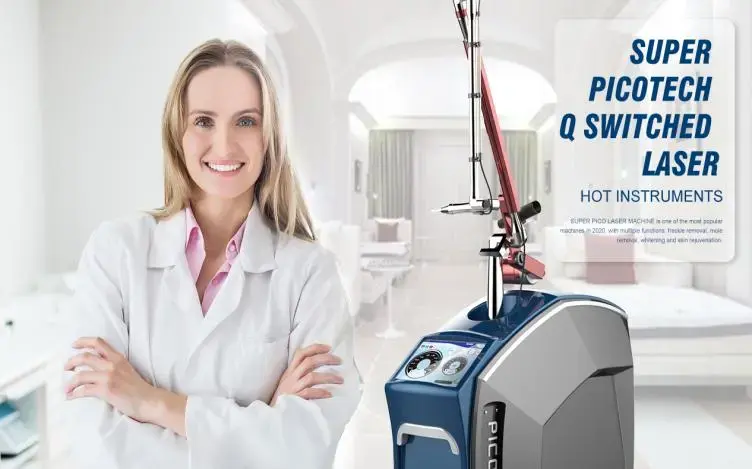
Q-Switch lasers use a quality-switching mechanism to generate energy in the laser cavity and release it in highly intense nanosecond pulses (6-20ns). This regulated energy supply causes photoacoustic effects that mechanically split tattoo ink particles into minuscule fragments for lymphatic system absorption and removal. The Q-switched Nd:YAG laser system includes a laser generator with the active medium, an articulated arm for precision beam delivery, a strong power supply, improved cooling infrastructure, and a display control system for treatment parameters.
The therapeutic premise of Q-Switch technology is selective photothermolysis. When the laser penetrates the epidermis and reaches tattoo pigments in the dermis, the nanosecond pulse gives ink particles tremendous energy. This fast energy absorption induces thermal expansion and fragmentation, separating cohesive pigment masses into micrometer-sized particles. Over weeks, the body's metabolic systems phagocytose these particles.
Picosecond Laser Advancements
Picosecond lasers generate pulses in trillionths of a second (350-750ps), the next generation of laser technology beyond traditional q switch tattoo removal machines. Ultra-rapid pulses increase photomechanical effect and limit thermal diffusion, reducing treatment sessions and tissue heating. Ultra Picotech uses seed source amplification to create true ultra-picosecond pulse widths for more intense pigment blasting with less tissue heat.
Comparing Q-Switch vs. Pico Laser Technologies
Laser tattoo removal equipment buyers must comprehend the practical distinctions between nanosecond Q-Switch systems and picosecond developments. Both technologies are clinically effective but differ in operational and budgetary aspects.
Treatment Effectiveness and Session Requirements
Professional tattoos take 6-12 sessions, two months apart, to clear using Q-Switch devices, but amateur tattoos react faster. The longer interval permits lymphatic clearance of broken particles. Due to photomechanical disruption, picosecond lasers diminish session counts by 20-30%, depending on ink density, color complexity, and placement depth.
Clinical results show pigment compatibility discrepancies. Through optimum wavelength selection (1064nm and 532nm), Q-Switch systems work well with black, blue, and red inks. Green and sky-blue hues withstand nanosecond pulses better. Superior photoacoustic pressure helps picosecond devices resolve these difficult hues, but numerous treatments are needed.
Capital Investment and Operational Economics
Beyond initial equipment expenses, financial analysis continues. Q-Switch systems cost $15,000 to $45,000, depending on manufacturer, features, and accessories. Picosecond devices cost $60,000–$150,000 due to their superior engineering and new market position. Maintenance, consumables (especially xenon flashlamps rated for 500,000 to 1 million shots), and energy usage must be factored into total cost of ownership estimates.
Operating factors include clinical staff training. Q-Switch technology accelerates staff competence development with decades of clinical experience and standardized treatment methods. For shorter pulse durations without excessive fluence, picosecond systems need more precise parameter tuning.
Key Benefits and Risks of Q Switch Tattoo Removal Machines
Professional aesthetic practices contemplating laser tattoo removal equipment find Q-Switch technology's clinical efficacy, affordable accessibility, and operational adaptability intriguing, driving wider adoption.
Core Clinical and Operational Advantages
Many Q-Switch advantages directly address beauty salon, wellness center, and dermatological clinic issues. Multi-wavelength capability gives these devices great versatility. The 532nm adapter clears ferric oxide red pigments and epidermal lesions like solar lentigines and freckles, while the 1064nm wavelength penetrates carbon-based black and dark blue inks. Advanced versions may employ 585nm/650nm dye handpieces to cure resistant green and brilliant blue tattoo inks
Clinical versatility of q switch tattoo removal machines goes beyond tattoo removal. Nevus of Ota, Hori's Macules, and cutaneous melanocytosis can be treated using the technique. The Hollywood Peel is a high-demand, zero-downtime rejuvenation therapy using carbon lotion as a chromophore. When the laser vaporizes carbon particles in pores, it exfoliates the stratum corneum, controls sebum production, and promotes collagen synthesis, improving skin texture and tone immediately.
The technique is safe for sensitive face features, neck regions, and thin skin areas where ablative treatments would pose prohibitive risks. This improved treatment capabilities let clinics serve more clients without procedural restrictions.
Risk Management and Safety Protocols
Responsible clinical practice recognizes and mitigates risks. In darker skin types (Fitzpatrick IV-VI) or when treatment parameters surpass acceptable fluence levels, post-inflammatory hyperpigmentation or hypopigmentation may develop. A thorough patient assessment that includes skin type, tattoo features, and medical contraindications before treatment greatly lowers complications.
Sessions should be spaced at least two months apart to allow lymphatic clearance of shattered pigment particles and inflammation resolution before the next treatment. Rushed treatment schedules enhance side effects without improving clearance.
Operator training affects safety and efficacy. Staff must know wavelength selection, spot size, and fluence calculations for different pigment kinds and depths, and skin cooling strategies. Regular distilled water changes in cooling systems (to minimize mineral scaling and electrical risks), flashlamp shot count monitoring, and optical component cleaning provide constant performance and prevent treatment equipment failures.
Procurement Guide: How to Select and Buy Q Switch Tattoo Removal Machines
Strategic equipment procurement demands rigorous consideration of technical parameters, manufacturer credentials, and economic terms to ensure long-term operational and financial success.
Critical Technical Specifications
Wavelength configuration is the main technical issue. Due to its adaptability, dual-wavelength systems (1064nm/532nm) can handle all tattoo colors in practical applications. The 755nm alexandrite wavelength is efficient against green and blue pigments, but complicates and costs more. Treatment success depends on energy output capacity, with 2000mJ/cm² fluence levels suitable for thick professional tattoos and resistant pigmented lesions. Operators can optimise energy density for different treatment regions and objectives using 2-10mm spot sizes.
Pulse length affects therapy results. Authentic Q-Switch systems pulse at 6-20 nanoseconds for excellent pigment fragmentation photoacoustics. Higher repetition rates (1-10Hz) reduce treatment duration but may increase tissue heat buildup.
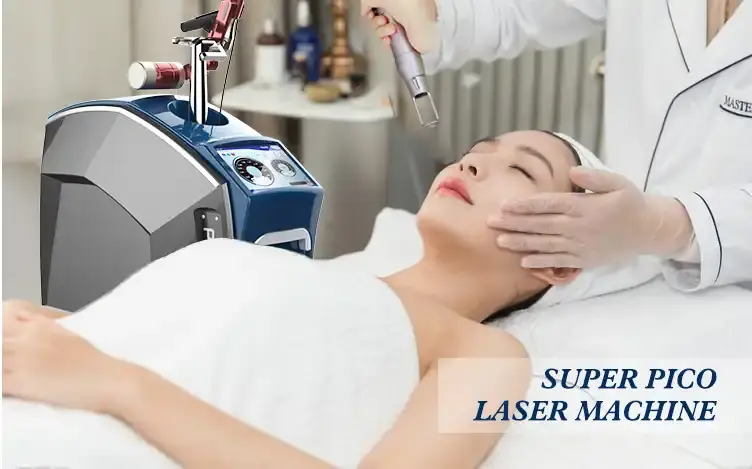
Physical design impacts healthcare workflow. Compared to handpiece-only solutions, articulated arm systems improve beam delivery precision and operator ergonomics. Display screen size (10.4-inch or bigger) improves parameter and treatment monitoring. Air-cooled systems are suitable for moderate-volume operations, whereas water-cooled systems are needed for high-throughput clinics to sustain performance over time.
Manufacturer Evaluation and Certification Standards
Equipment sourcing for q switch tattoo removal machines must include manufacturer reputation, regulatory compliance, and support infrastructure. Established worldwide brands charge more but have significant clinical validation and service networks. Chinese manufacturers provide comparable quality at affordable prices, which is important for tattoo removal procedures, joining the market or growing capacity.
Regulatory certification ensures quality and simplifies clinical credentialing. ISO13485 accreditation proves medical device quality management compliance. CE marking certifies European health, safety, and environmental protection requirements. Practitioners servicing U.S. markets should favor FDA-approved products with strict safety and effectiveness standards.
After 15 years of production and international distribution, Xi'an Taibo Laser Beauty meets professional manufacturing requirements. Their Q-Switch devices use military-grade technology for accurate pulse control at reasonable prices for varied practice kinds. Procurement managers trust ISO13485 and CE certification for regulatory compliance and product quality.
Future Trends and Innovations in Tattoo Removal Lasers
Technological advancement and clinical awareness in the aesthetic laser business present potential and strategic challenges for equipment procurement specialists.
Hybrid Pulse Technology
Emerging platforms with picosecond and nanosecond pulse capabilities allow operators to choose the best pulse length for treatment scenarios. Tech convergence gives resistant pigments picosecond advantages and regular treatments nanosecond dependability, enhancing therapeutic adaptability and minimizing capital expenditure.
Artificial Intelligence Integration
Smart interfaces with AI-driven parameter recommendation algorithms use skin type, tattoo attributes, and treatment history to determine wavelength, fluence, and spot size. Decision assistance technologies reduce operator learning curves and treatment variability, which is useful for practices with rotating personnel or increasing services.
Portable and Modular Designs
Compact systems serve the developing mobile aesthetics industry, where practitioners work at different sites. Flexible deployment methods that enhance market reach without infrastructure investment are possible because of lightweight design, battery operation, and easier setup.
Conclusion
The q switch tattoo removal machine remains the most successful and dependable professional tattoo removal technology in many clinical situations. Selective photothermolysis clears pigments consistently and safely across all skin types using this established platform. Beyond tattoo removal, the technology may rejuvenate carbon peels, treat pigmented lesions, and offer additional aesthetic practice revenue streams. Procurement professionals choosing equipment should favor manufacturers with extensive certification, strong after-sales service, and competitive prices to maximize ROI. As the aesthetic laser industry evolves, Q-Switch technology is a strategic investment that provides clinical competence immediately and long-term operational success.
FAQ
1. How many treatment sessions does Q-Switch laser tattoo removal typically require?
Ink density, color complexity, depth of placement, and immune system effectiveness affect the clearance of professional tattoos, which usually take 6-12 sessions spaced two months apart. Amateur tattoos fade faster, sometimes in 4-6 sessions. The long period between treatments helps the lymphatic system to handle and remove fractured pigment particles as inflammation diminishes.
2. Is Q-Switch laser tattoo removal safe for all skin types?
Q-Switch technology is safe for all Fitzpatrick skin types (I-VI) when operated by skilled professionals following regulations. Darker skin types (IV-VI) are at risk for post-inflammatory hyperpigmentation or hypopigmentation, requiring conservative fluence levels and close monitoring. Comprehensive pre-treatment assessment of skin features, medical history, and reasonable outcome expectations greatly decreases complications.
3. What factors should clinics consider when comparing Q-Switch manufacturers?
Wavelength configurations, peak energy output, certification standards (ISO13485, CE, FDA clearance), warranty duration and scope, after-sales technical support responsiveness, training resource comprehensiveness, and total cost of ownership, including consumables replacement schedules, are important evaluation criteria. Manufacturer reputation from years of manufacturing and international distribution boosts product dependability and spares availability.
Partner with a Trusted Q Switch Tattoo Removal Machine Manufacturer
Xi'an Taibo Laser Beauty serves beauty salons, wellness centers, and dermatological clinics in 180 countries with over 15 years of aesthetic equipment production expertise. Our q switch tattoo removal machine provider offers clinical-grade performance with 755nm/1064nm/532nm wavelengths, 2000mJ/cm² peak energy output, and hybrid cooling systems for constant operation in high-volume practices. Our ISO13485 and CE accreditation shows our dedication to worldwide quality standards, and our technical staff provides training, troubleshooting, and unique OEM solutions. Our low pricing and flexible procurement terms maximize investment returns for tattoo removal services and capacity expansion. Talk to susan@taibobeauty.com now to see how our proven technology and devoted partnership strategy may improve your clinical capabilities and customer happiness.
References
1. Anderson, R.R., & Parrish, J.A. (1983). "Selective Photothermolysis: Precise Microsurgery by Selective Absorption of Pulsed Radiation." Science, 220(4596), 524-527.
2. Bernstein, E.F. (2007). "Laser Treatment of Tattoos." Clinics in Dermatology, 24(1), 43-55.
3. Kirby, W., Desai, A., Desai, T., Kartono, F., & Geeta, P. (2013). "The Kirby-Desai Scale: A Proposed Scale to Assess Tattoo-Removal Treatments." Journal of Clinical and Aesthetic Dermatology, 6(7), 32-37.
4. Ross, V., Naseef, G., Lin, G., Kelly, M., Michaud, N., Flotte, T.J., Raythen, J., & Anderson, R.R. (1998). "Comparison of Responses of Tattoos to Picosecond and Nanosecond Q-Switched Neodymium: YAG Lasers." Archives of Dermatology, 134(2), 167-171.
5. Tanzi, E.L., & Alster, T.S. (2004). "Q-Switched Ruby Laser Treatment of Tattoos and Benign Pigmented Lesions: A Critical Review." Dermatologic Surgery, 30(2), 169-177.
6. Weiss, E.T., Brauer, J.A., & Anolik, R. (2011). "1064 nm Q-Switched Nd:YAG Laser for the Treatment of Argyria: A Systematic Review." Journal of Drugs in Dermatology, 10(12), 1447-1450.





YOU MAY LIKE