
Step-by-Step Guide to OPT SHR Laser Hair Removal Treatments
2026-05-06 10:06:21
opt shr laser hair removal is a big step forward in beauty technology because it gets rid of hair permanently with little pain. This new method is different from traditional intense pulsed light systems because it blends Optimal Pulse Technology with Super Hair Removal techniques. It does this by slowly heating the skin with short, low-energy bursts that happen at frequencies up to 10Hz. With the In-Motion sliding method, therapists can treat big areas like legs and backs in about 15 minutes. Sapphire cooling keeps clients comfortable. This technology safely removes hair from Fitzpatrick skin types I through VI. This makes it perfect for a wide range of clients in current beauty practices.
Understanding OPT SHR Laser Hair Removal Technology
To get rid of hair effectively, you need to understand the science behind these high-tech methods. Today's beauty salons need tools that are both safe and effective, and OPT SHR laser hair removal technology has become the gold standard.
How OPT SHR Technology Works
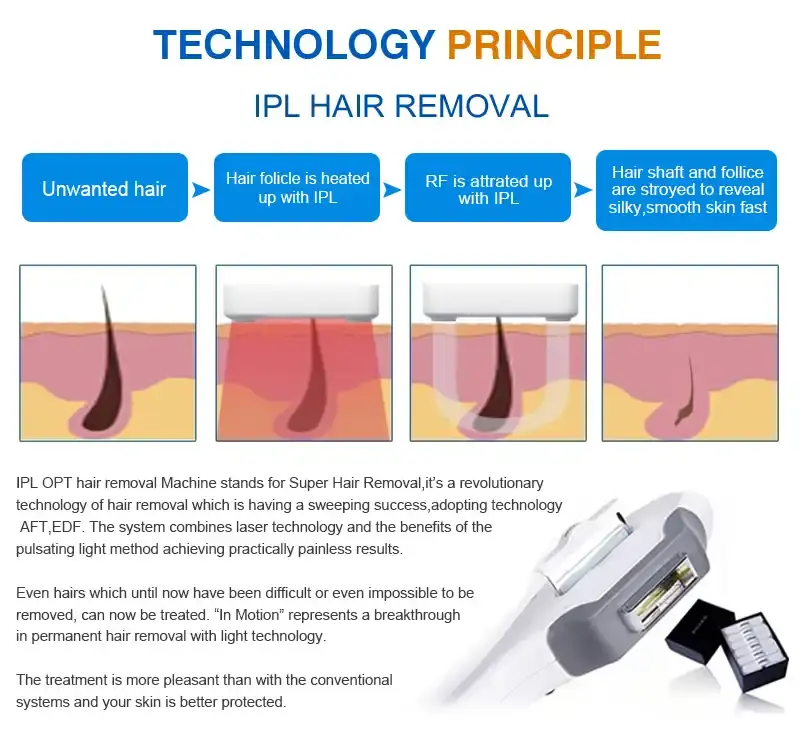
This method is based on selective photothermolysis, which happens when melanin in hair follicles absorbs certain colors of light. For IPL tasks, OPT systems use a range of bands from 430nm to 750nm, as well as Nd: YAG wavelengths at 532nm, 755nm, 1064nm, and 1320nm. Because of this, practitioners can tailor therapy to each patient's hair color, skin type, and treatment goals. The system gives out energy ranging from 1 to 50 J/cm² for IPL uses and 1 to 2000mJ for Nd: YAG uses, so it can be used in a variety of treatment situations. The pulse form adjustment is what makes OPT different from regular IPL. Traditional IPL sends out energy in jerky spikes that can be painful and give uneven effects. OPT technology makes a perfect square wave, which makes sure that the energy is spread out evenly in every pulse. This improvement lowers the high power levels while keeping the therapeutic effects the same. This makes pain feelings and the risk of thermal damage much lower.
The Super Hair Removal Advantage
The Super Hair Removal method changes the way treatments are done by using high repetition rates with low fluence levels. Instead of sending out short, powerful bursts that heat tissue quickly, SHR exposes the dermis over and over again, building up thermal energy over time. This method of slowly heating targets stem cells in hair follicles and structures in the dermal papilla without hurting other tissues in the area. With the In-Motion method, the handpiece can be moved continuously over the treatment area, and the machine can send out up to 10 pulses per second. This steady motion makes sure that the whole area is covered evenly while the heating effect builds up to the goal temperature of about 45°C in the dermis. For clients, this feels like soft warmth instead of snapping sounds. Studies in humans show that SHR methods need four to six treatments to get rid of hair permanently, while standard IPL systems need six to twelve treatments. This level of speed directly leads to happier clients and higher profits for the business. Professional systems have a 15x50mm spot size that lets them cover a lot of ground quickly. This cuts the time it takes to treat the whole leg from 45 minutes to about 15 minutes.
Safety Features and Certifications
Professional-grade systems have many safety OPT SHR laser hair removal features that keep both clients and workers safe. Sapphire TEC cooling and water cooling systems keep the temperatures of the handpieces well below the point where they become uncomfortable. Some of the more modern models can reach surface temperatures of -20°C. This strong cooling makes it safe to treat sensitive areas like the face, bikini line, and underarms. Equipment from good makers has CE approval and ISO13485 compliance, which shows that it meets international standards for medical devices. These certifications give people who buy things faith that the tools they're buying meet strict quality and safety standards. Using xenon lamps made in the UK that last longer than 500,000 shots guarantees long-term dependability and regular repair costs. Advanced filtration systems use PP cotton filters and ion filters to keep the water clean over long periods of time. This is done to avoid material buildup that could lower the cooling efficiency. The 10.4-inch color touch LCD screen makes it easy to change treatment settings. For example, operators can change frequency, energy levels, and pulse length in real time based on what clients say and how the tissue reacts visually.
Step-by-Step Treatment Process of OPT SHR Laser Hair Removal
For treatment to work, it's important to follow the rules exactly at every step of the client's trip. Knowing this process helps procurement teams figure out what tools can do and what training is needed for OPT SHR laser hair removal.
Pre-Treatment Consultation and Assessment
The treatment process starts with a full interview, during which a practitioner decides if the client is a good fit for treatment. A study of the patient's medical background shows any problems that should not happen, like being pregnant, having an active infection, being in the sun recently, or taking medicines that are sensitive to light. Using the Fitzpatrick classification method to type the skin tells us what energy settings and wavelengths to use. An important part of this time is managing realistic expectations. Professionals say that getting rid of hair for good usually takes more than one session, spaced out 4 to 6 weeks apart. The results depend on the person's hair growth cycle, hormones, and genetics. There are photos from before the treatment, permission forms that have been signed, and thorough notes about the treatment areas and the hair density at the start.
Equipment Setup and Calibration
Professional standards require that all tools be carefully prepared before each session with a client. Operators make sure that the water level is right, that the filter systems are working properly, and that the cooling systems are at the right temperature. The handpiece is looked at to see if it has any damage or signs of wear, and tests are done to make sure that the energy output fits the settings on the display. Cleaning the face to get rid of makeup, oils, and other things that could block light is part of preparing the treatment area. Before the treatment, clients must have shaved the areas that will be treated 24 hours in advance. This leaves the hair follicles below the skin untouched while getting rid of any hair on the skin's surface that could waste energy. Both clients and workers must wear protective eyewear that blocks certain wavelengths and is compatible with the system's output.
Treatment Execution Technique
The use of ultrasound gel has several benefits: it creates a visual link between the handpiece and the skin, makes moving easier, and improves the cooling effect. The layer of gel should be about 1-2 mm thick and spread out evenly over the whole treatment area. For the In-Motion method to work, users must keep moving continuously while applying constant contact pressure and making passes that overlap. The machine sends out about 10 pulses per second, and practitioners usually go over each treatment area three to four times. This repeated contact slowly heats up the structures that are being targeted, while the cooling system keeps the skin safe. Clients say they feel mild warmth to soft tingling, which is very different from the painful snapping that comes with standard lasers. Energy levels need to be carefully adjusted based on the type of skin, hair, and sensitivity of the treatment area. Conservative methods start with lower energies and slowly raise them based on how well the person can handle them and how the tissue responds.
Comparative Analysis: OPT SHR vs Other Laser Hair Removal Technologies
When making choices about what to buy, OPT SHR laser hair removal, it is very helpful to know how different technologies perform on key measures. This study gives fair comparisons for OPT SHR laser hair removal that help choose equipment that meets the wants of the target market.
Performance and Effectiveness Comparison
Traditional diode lasers with an 808nm frequency work very well on lighter skin tones, but not so well on darker skin tones because darker skin absorbs more melanin through the epidermis. Alexandrite lasers at 755nm have the fastest treatment times and work best on light to medium skin with dark hair. They can't safely treat darker or brown skin, though. IPL devices are flexible because they can output different wavelengths, but they usually need more treatment sessions than laser options. OPT SHR technology fills in these gaps by mixing the ability to work with different wavelengths with the best possible pulse transmission. Being able to safely treat Fitzpatrick skin types I through VI increases the number of people who could become clients. This is especially helpful in diverse urban areas. Treatment works as well as or better than traditional methods while needing fewer sessions. This has a direct effect on how happy clients are and how efficiently clinics can schedule appointments. Electrolysis is still the only FDA-approved way to get rid of hair for good. It works by chemically breaking down hair cells one at a time.
Pain and Comfort Considerations
Treatment retention and transfer rates are directly affected by how comfortable the client is. People who have used traditional laser systems often say that they hurt a lot, like when a rubber band snaps against the skin. This feeling is caused by high peak energy levels during single-pulse release. Some clients can't handle sensitive areas like the bikini line or face anymore, which means they have to stop treatment. The way SHR technology heats things up slowly changes the comfort situation in a big way. The method keeps nociceptor activation to a minimum by spreading heat buildup over several low-energy pulses and using active cooling. According to clinical comments, clients always say that treatments are comfy enough that they can relax or even sleep during sessions. This is very different from traditional laser treatments, which can be tense.
Cost and ROI Analysis
Costs to buy equipment for professional OPT SHR systems vary from modest to high investments, based on the brand and configuration. But operating effectiveness and lower costs for consumables help make return on investment timelines look good. Quality xenon lamps have a life span of 500,000 shots, which means that they don't need to be serviced often and only cost a small amount per shot. Clinics can charge higher prices for treatments that are comfy and work well when the market is competitive. Being able to treat bigger areas more quickly lets you treat more patients, which increases your income per treatment hour. The maintenance needs are simple and mostly involve keeping the water system in good shape and calibrating it on a regular basis. This keeps the running costs low. When procurement teams figure out the total cost of ownership, they should take into account the cost of training, the cost of covering the warranty, and the availability of expert help. Downtime risks are lower, and investment value is protected with equipment that comes with full two-year warranties and quick expert help.
Selecting and Procuring OPT SHR Laser Hair Removal Equipment
Choosing equipment is a big investment choice that will have long-lasting effects on how well the business can run. Systematic review across key aspects makes sure that purchases of OPT SHR laser hair removal tools are in line with both operational needs and strategy goals.
Essential Technical Specifications
Output power is one of the most important specs, and professional systems usually come with 2000W power sources. This strong power makes it possible to give steady energy over long treatment sessions without lowering performance. With frequency sets that can be changed from 1Hz to 10Hz, the treatment strength can be changed to fit the needs of the client and the treatment area. Screen interfaces have changed over time to 10.4-inch color touch screens that make it easy to move around in settings with a lot of parameters. Interfaces that are easy to use cut down on training time and user mistakes that could hurt treatment results. Having the ability to save personalized treatment plans for different types of clients speeds up work and ensures that all workers follow the same rules. The design of the cooling system should be carefully thought out because it has a direct effect on the comfort and safety of the clients. The current standard is dual-cooling systems that use both water cooling and sapphire TEC technology to keep the handpiece temperatures well below the levels that tissues can handle.
Certification and Compliance Standards
Different markets have different rules about medical devices, but CE approval and ISO13485 compliance are good ways to make sure they are of good quality. The CE mark shows that the product meets European standards for health, safety, and environmental protection. The ISO13485 mark shows that the product follows quality management systems that are specific to making medical devices. When buying things for the US market, procurement teams should check to see if the products are registered with the FDA. This lets them serve medical offices and makes sure they follow strict safety rules. Manufacturers who are trying to get FDA approval show that they are dedicated to quality and following the rules, which usually means that their products are more reliable. Ask for proof that the certificate is real, such as the certificate number and information about the awarding body. Manufacturers with a good reputation will gladly give you full certification paperwork and testing results that back up their performance claims and safety ratings.
Supplier Evaluation and Selection
Experience of the manufacturer has a big effect on the quality of the product and the provision of long-term assistance. The Xi'an Taibo Laser Beauty company has been making laser beauty tools for more than 15 years and has built trade partnerships with more than 180 countries. This long history of operations shows that the company has a proven ability to make reliable goods and keep up with ongoing support infrastructure.OEM and ODM skills allow for branding, personalization, and feature optimization that fit a specific market placement. Companies that provide these services can change the user interfaces, treatment methods, and even the technology setups to make their products stand out. Language customization services make it possible for tools to be adapted for places where people don't speak English. There are no minimum order requirements. Transaction friction is reduced by being able to pay through a variety of methods, such as bank transfers, credit cards, and different payment systems. Bulk purchase prices are given to people who commit to buying a lot, and sales of more than one unit can save you a lot of money.
Maximizing Business Outcomes with OPT SHR Laser Hair Removal Solutions
Strategic technology usage includes more than just buying tools. It also includes marketing, teaching operators, and making the customer experience better for OPT SHR laser hair removal clients. Implementations that work well set businesses apart from their competitors and lead to long-term income growth.
Marketing and Client Education Strategies
Marketing that works well tells end users about the unique benefits OPT SHR laser hair removal of OPT SHR technology in a way that sticks with them. A lot of clients want treatments that don't hurt, sessions that last less time, and treatments that work for all skin types. Having before-and-after pictures that show how the hair loss happened builds trust and sets realistic goals. Clinic websites, social media pages, and consultation papers with educational information make practices look like they are full of knowledge. By explaining the science behind slow heating and why this way is better than others, you can build trust and justify charging more. Video comments from happy customers are a strong form of social proof that can help potential customers decide what to do. Package pricing encourages clients to commit to a full treatment run instead of just one session. Giving savings for pre-paid treatment plans helps with cash flow and makes sure that treatment stays consistent, which improves results. Referral reward programs use the networks of happy customers to bring in new customers at a low cost.
Operational Excellence and Staff Training
The skill of the operator directly affects how well the treatment works and how happy the client is. Technical theory, hands-on experience with different skin types and treatment areas, and learning how to talk to clients should all be part of thorough training programs. When manufacturers offer free training along with their products, it makes it easier for people to use them and speeds up the process of becoming proficient. Standardized treatment methods make sure that the same results are seen by all workers and in all treatment sessions. Variations that could hurt results are kept to a minimum by using detailed plans that cover things like pre-treatment evaluation, equipment setup, execution method, and care after treatment. Continuous improvement cultures are built through regular staff meetings where tough cases are discussed and new techniques are shared. Booking sites that are linked with client management systems make it easier to make appointments, keep track of treatments, and send automated follow-up messages.
Future Trends and Innovation Outlook
The aesthetic gadget business is still changing quickly, with new technologies offering better features. Soon, combining AI may make it possible for parameters to be automatically optimized based on watching tissue reaction in real time. These kinds of devices could change the amount of energy and the length of the pulses on the fly to get the best results while still staying safe. Combination stations that combine multiple modes of transportation give operators more options and make better use of space. Devices that combine OPT SHR hair removal with skin renewal, vascular treatment, and color correction make it possible to get a wide range of services from a single piece of equipment. This flexibility brings in a wider range of clients and raises the clinic's income per square foot. Portable and well-designed adjustable systems make it easier for the therapist to be comfortable during long treatment sessions. More and more, when designing equipment, operator experience and client outcomes are taken into account. This is because it is known that practitioner happiness affects the level of treatment. With wireless handpiece technology, you don't have to worry about managing cords, and you can freely move around treatment areas.
Conclusion
The OPT SHR laser hair removal technology is a game-changer for beauty salons that want quick, safe, and easy permanent hair removal options. When you combine optimized pulse technology with super hair removal technique, you get around the problems that earlier treatments had with pain, length of treatment, and skin type limits. A full understanding of treatment methods, the pros and cons of different technologies, and strategy procurement issues is necessary to make smart equipment choices. For implementations to go well, operators need to be trained, clients need to be educated, and there needs to be operational excellence that improves both healthcare results and business performance. There is a lot of clinical data to support this technology, and it is used all over the world in a wide range of work settings.
FAQ
1. How many treatment sessions are needed for permanent hair reduction?
Most people need between 4 and 6 treatments, spaced out over 4 to 6 weeks for body parts and 3 to 4 weeks for face parts. Treatments can only change hair follicles that are actively growing hair. Having more than one session makes sure that all of the follicles get treatment while they are growing. Results are different for each person because of biological factors, genetics, and the way the treatment area is set up. Maintenance sessions might be needed once a year.
2. Is OPT SHR safe for all skin types?
The system can safely treat Fitzpatrick skin types I through VI, even skin that is brown. Longer wavelengths, like 1064nm, go deep into the skin without absorbing much melanin from the epidermis. This makes it safe to treat darker skin tones. Gradual heating and harsh cooling work together to protect the skin and target hair follicles effectively. Choosing the right parameters after a thorough skin assessment ensures that treatments are safe and useful for a wide range of people.
3. What are common side effects, and how long do they last?
Clients usually have mild redness that looks like a light sunburn and goes away in two to four hours. A little swelling may happen around the treated hair shafts, but it goes away quickly. Hyperpigmentation can happen temporarily in people with darker skin if the settings are not set correctly. Complication risks are lower if you follow the care directions given after treatment, which include staying out of the sun. With the right method and tool calibration, serious adverse events are very rare.
Partner with Taibo Laser for Superior OPT SHR Solutions
With the best OPT SHR laser hair removal tools on the market, Taibo Laser Beauty is ready to help your aesthetic business grow. Our industrial experience of more than 15 years guarantees that you will get solid, certified technology backed by a full support system. We offer customizable OEM and ODM services that make sure the specs of the tools you need fit your specific brand positioning and requirements. In addition to providing tools, we also offer full application support, which includes training for operators, marketing materials, and technical help through our 24-hour support team. Our two-year warranty coverage exceeds industry standards. During the warranty time, we will replace any damaged parts for free, protecting your investment. Our options are flexible enough to fit your needs, whether you run a single-location spa or a network of multiple beauty clinics. Email Susan at susan@taibobeauty.com to talk about your unique needs and find out how our services as an OPT SHR laser hair removal provider can help your business grow faster. You can ask for thorough technical specs, pricing for large orders, and details about our full training programs. Set up a meeting to see for yourself how our dedication to quality and teamwork has made Taibo Laser a trusted manufacturer that serves more than 180 countries around the world.
References
1. Anderson, R.R., & Parrish, J.A. (1983). Selective photothermolysis: Precise microsurgery by selective absorption of pulsed radiation. Science, 220(4596), 524-527.
2. Goldberg, D.J. (2012). Laser Hair Removal: Current Concepts and Controversies. Journal of Clinical and Aesthetic Dermatology, 5(11), 32-37.
3. Haedersdal, M., Beerwerth, F., & Nash, J.F. (2011). Laser and intense pulsed light hair removal technologies: from professional to home use. British Journal of Dermatology, 165(Suppl 3), 31-36.
4.Lanigan, S.W. (2003). Management of unwanted hair in females. Clinical and Experimental Dermatology, 28(4), 369-373.
5. Ross, E.V., Ladin, Z., Kreindel, M., & Dierickx, C. (1999). Theoretical considerations in laser hair removal. Dermatologic Clinics, 17(2), 333-355.
6. Town, G., & Ash, C. (2010). Are all IPL devices the same? A comparative review of performance specifications. Journal of Cosmetic and Laser Therapy, 12(6), 296-302.





YOU MAY LIKE