
Portable Fractional CO2 Laser for Skin Tightening and Wrinkle Reduction
2026-07-14 09:14:03
The portable fractional co2 laser is a game-changer in modern cosmetic medicine. It provides precise skin tightness and wrinkle reduction in a small, clinic-ready package. These devices, unlike bulky traditional systems, bring hospital-grade fractional photothermolysis to a wide range of practice settings, from small medical spas to dermatology groups with multiple locations. As people who buy things look at what they can afford, it's important for them to know about the technical complexity, clinical versatility, and operational benefits of these systems so that they can stand out from the competition and keep patients happy.
Understanding Portable Fractional CO2 Laser Technology
The Core Principle of Fractional Photothermolysis
Microthermal Treatment Zones, which are managed micro-injuries, are what this technology is based on. These gadgets use an RF-excited metal tube solid-state laser to send out laser energy with a frequency of 10,600nm. This laser can go through skin up to 4mm deep. Instead of fixing the whole surface, the fractional method only tackles 15–20% of the tissue, leaving the rest of the area unaffected to speed up the healing process. Compared to traditional ablative resurfacing, this selective damage causes fibroblasts to activate and strong collagen remodelling while cutting patient downtime by a huge amount.
Technical Architecture That Delivers Clinical Results
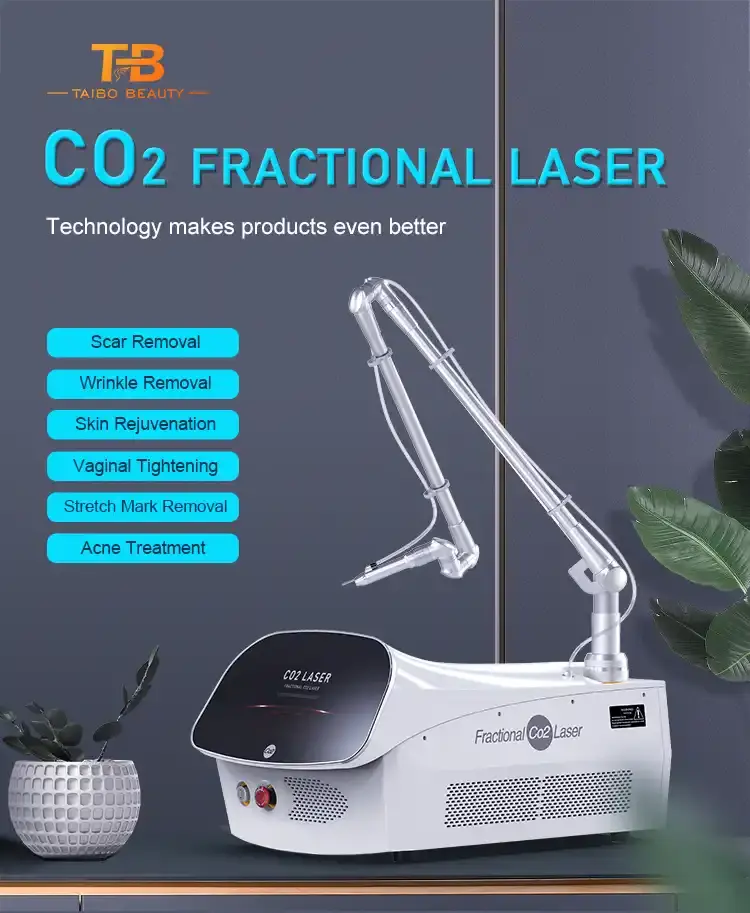
Modern systems have seven-joint articulated light guide arms that deliver the beam precisely and keep spot sizes as small as 0.1 mm for very accurate treatment. The metal tube design lasts longer (usually 5 to 7 years) than glass tube options, which break down in 24 months. Water cooling systems keep the power output steady between 1W and 40W, which lets them treat in a number of different ways, such as dot matrix, long pulse, super pulse, and specific vaginal rejuvenation methods. The 10.4-inch touch screen makes it easy to control, and the 635nm indicating light makes sure that you can see when you're aiming correctly during procedures.
Portability Without Performance Compromise
These small units go against the usual idea that more space means more power. They offer clinical-grade fluences of up to 70–100 mJ per dot, which is enough for surgical-grade cutting and fading of deep acne scars, while also reducing the equipment's footprint by over 60%. Because the devices are mobile, practitioners can use them in more than one treatment room or even in mobile aesthetic practices. This lets them make the most of their assets and make more money without sacrificing therapeutic outcomes.
Comparing Portable Fractional CO2 Lasers with Other Laser Technologies
Performance Distinctions Across Laser Modalities
Compared to erbium YAG lasers, portable fractional co2 lasers can penetrate deeper into the skin, which is important for treating scar tissue and photoaging. Non-fractional CO2 lasers can completely remove skin, but they require 14–21 days of recovery, which many patients don't want to do. With fractional delivery, downtime is cut down to 5–7 days, and long-term effects are the same. The portable fractional CO2 laser meets specific clinic process needs that stationary units can't, like being able to move equipment between procedure rooms or provide treatments in satellite sites without having to buy two sets of equipment.
Addressing Clinical Limitations Transparently
Practitioners should know that fractional systems need more than one treatment session to work best, usually three to five sessions spaced four to six weeks apart. Coverage area per session is still smaller than with non-fractional methods, which makes the whole process take longer for big body parts. In real-life practice settings, however, the benefit of better patient comfort and lower chance of complications always outweigh these factors. Another factor is the need for specialised training; staff must learn the right way to choose fluence and scan patterns to avoid thermal problems or results that aren't consistent.
Applications and Use Cases in Skin Tightening and Wrinkle Reduction
Facial Rejuvenation and Wrinkle Management
For periorbital rhytids, nasolabial folds, and forehead wrinkles, clinical protocols show that the treatment works very well. For delicate areas around the eyes, treatment factors usually run from 30 to 70 mJ per dot at 5 to 10 percent density. For thicker tissue in the cheeks and jowls, they rise to 100 mJ and 20 percent density. As neocollagenesis continues to work, patients will see their skin stiffening within 7–10 days of treatment. The increase will last for another 3–6 months. To treat thin eyelid skin without risk of ectropion, the ultra-pulse mode keeps thermal spread to a minimum.
Scar Revision and Textural Improvement
The portable fractional CO2 laser treatment works especially well on acne scars grade III to IV. The machine makes controlled ablative columns that get rid of scar bands made of fibres and encourage the growth of healthy tissue. Hypertrophic scars and keloids can be helped by getting rid of extra collagen. Darker skin types can avoid hypopigmentation by carefully choosing the parameters. Striae gravidarum treatment uses lower density settings and multiple passes to change the dermal architecture slowly over the course of 4 to 6 sessions.
Intimate Wellness Applications
Through thermal stimulation of the vaginal mucosa, the specialised vaginal rejuvenation mode treats genitourinary syndrome of menopause and stress urinary incontinence. The 360-degree probe has a uniform thermal effect that causes tissue to contract right away and elastin to regenerate over time. This non-surgical method gives patients a private option to invasive procedures, which is a great way for clinics to make extra money. Concerns about hyperpigmentation can be addressed with vulvar whitening treatments that use carefully controlled shallow ablation.
Safety rules are still the most important thing in all situations. Devices that are approved to CE and ISO 13485 standards work consistently and follow the rules. Bad things that happen are kept to a minimum by properly preparing the skin before treatment with a topical anaesthetic and properly caring for wounds after surgery with a shield. Active infections, immunosuppression, and patients with high hopes needing careful review are all reasons why this treatment should not be used.
How to Choose and Procure the Best Portable Fractional CO2 Laser
Critical Technical Specifications for Evaluation
When it comes to dependability and beam quality, procurement teams should choose RF metal tube lasers over glass alternatives. Make sure the actual power output is higher than what was stated. Units from reputable brands like Taibo Laser that are rated at 1-40W actually deliver over 40W. The number of flexible arm joints directly affects how easily it can be moved. Systems with seven joints offer more moving options in small treatment rooms. Duty cycle is based on the cooling system's capacity; water-cooled designs allow for continuous operation on days when there are a lot of patients.
Interface design affects how quickly and well staff can learn new things. Touch-screen controls with visual images of treatment patterns cut down on code mistakes and make it easy to quickly change parameters between patients. Multiple output modes (dot matrix, pulse variations, private/vulvar settings) on a single platform give doctors more options without having to buy more than one gadget. Spot size can be changed from 0.1mm up, which lets doctors do treatments ranging from precise work around the eyes to covering a larger area.
Supplier Assessment and Risk Mitigation
It's not enough to just look into what makers say about themselves when judging them. Taibo Laser has been making lasers for 15 years and has a foothold in 180 countries, which shows that it is stable and knows how to sell. With direct factory relationships, there is no markup for the distributor, and the warranty support is real. Ask for proof of CE and ISO 13485 certificates, along with dates that show when they are still good. When a factory has separate production lines, R&D departments, and quality inspection departments, it means that the operations are complex and can produce consistent results.
The terms of the warranty have a big effect on the total cost of ownership. Standard two-year coverage should include replacement parts for failures that were not caused by the user, and it should be clear which parts are not covered. When problems with the tools make it impossible to keep a meeting, after-sales support infrastructure like 24-hour technical help, video training materials, and multilingual service teams come in handy. Suppliers who give on-site training for large orders show that they care about their customers' success after the original transaction.
Negotiation Strategies and Financial Considerations
When you buy in bulk, you can get better prices and longer payment terms. To avoid budget surprises, people who work in procurement should ask for detailed quotes that include shipping, customs clearance, and installation costs. The quality of the packaging is important. Aluminium alloy boxes with custom foam inserts keep fragile optical components from getting damaged during shipping. Having a choice of shipping methods (air, sea, and rail) lets you combine cost and arrival time.
Having a variety of payment methods lets different business processes work. Larger institutions can use bank transfers to buy things, while small businesses can use credit cards to manage their cash flow. Setting performance goals that are tied to payment stages protects the buyer's interests. For example, you could set up a 30% deposit, 60% pre-shipment, and 10% holding until the installation is confirmed to have been successful.
Future Trends and Innovations in Portable Fractional CO2 Laser Technology
Artificial Intelligence Integration
New systems use AI to analyse the skin and suggest the best treatment settings based on the type of skin (Fietzpatrick), the features of the lesion, and the results that are wanted. Real-time impedance monitoring changes the energy delivery to keep the ablation depth the same across different body parts. This lowers the reliance on the operator and the variation in the outcome. Machine learning algorithms look at treatment records to make protocols better. This speeds up the evidence-based optimisation loop that used to take years of clinical observation.
Enhanced Precision and Control Mechanisms
Next-generation scanning systems can place things accurately within 100 microns thanks to better galvanometers and better lenses for focusing the beam. With this level of accuracy, doctors can make personalised treatment plans with different densities, geometric shapes, and asymmetrical designs that address specific aesthetic concerns in a way that is also artistically flexible. Continuous thermal mapping is possible with temperature monitoring sensors, which automatically change the power to keep sensitive areas from getting too hot.
Connectivity and Practice Management Integration
Devices that are connected to the cloud sync treatment data with electronic medical records. This makes documentation easier and lets you track outcomes over time. Integrated camera devices take standard pictures of the before and after at set times, which can be used for marketing and clinical evaluation. With remote diagnostics, maker support teams can solve problems with equipment over secure connections. Often, problems can be fixed without sending a worker and the downtime that comes with it.
These new ideas put forward-thinking practices in a better position to give patients unique experiences while also making operations run more smoothly. When making decisions about what to buy, including upgrade paths and backward-compatible accessories protects investments in portable fractional CO2 laser technology from quickly becoming obsolete.
Conclusion
Getting a portable fractional CO2 laser is a big strategic move that will affect your professional skills, patient happiness, and ability to compete. The technology has been shown to work for tightening skin, getting rid of wrinkles, fixing scars, and providing personal health services. This creates multiple income streams on a single platform. Procurement decisions that are in line with the organization's goals are made after a careful look at technical specifications, supplier credentials, and long-term support infrastructure. As new technologies keep improving the accuracy of treatments and the combination of operations, practices that adopt them quickly will be at the forefront of providing beauty medicine.
FAQ
1.What distinguishes RF metal tube lasers from glass tube alternatives?
RF metal tube systems have better beam quality than glass tube systems; spot sizes can reach 0.1 mm, while they only reach 0.25 mm for glass tubes. The metal construction lasts 5–7 years, compared to 1–2 years for glass alternatives, which lowers the cost of replacement over time. Consistent power flow over the device's lifetime guarantees consistent clinical results without decreasing effectiveness over time.
2.How do portable units compare to floor-standing systems in treatment outcomes?
In terms of treatment results, how do portable fractional CO2 lasers compare to floor-standing systems? Portable and fixed units give the same clinical results when they have the same power supplies and tube specifications, like 30W RF tubes. The main difference is the constant job cycle ability for long surgical sessions. Standard aesthetic standards work well with movable system cooling, so for most practices, the smaller size and lower costs are the most important factors.
3.What maintenance requirements should clinics anticipate?
As part of regular upkeep, the flexible arm lenses and scanner windows need to be cleaned so that dust doesn't build up and absorb laser energy, which could cause the lenses to break. Professional alignment calibration once a year makes sure that the beam delivery is at its best. Wearable parts include protected handpiece tips and focusing lenses, which need to be replaced based on the amount of treatment. Suppliers with a good reputation give detailed maintenance schedules and learning materials.
Partner with Taibo Laser for Your Portable Fractional CO2 Laser Needs
Taibo Laser has been a dedicated portable fractional CO2 laser supplier for 15 years and has delivered clinically proven systems to aesthetic practices in 180 countries. Our factory-direct plan lets us offer low prices without lowering the quality standards that have been proven by CE and ISO 13485 certifications. Before being expertly packed in custom aluminium cases made to protect optical parts during international shipping, each device goes through a series of intensive tests in our quality inspection department.
Our dedication goes beyond just delivering tools. The full two-year warranty covers all non-consumable parts, and our specialised after-sales team is available 24 hours a day, 7 days a week to help with technical issues in multiple languages. Your staff will quickly become proficient thanks to video training materials, full operating guides, and remote troubleshooting. When you buy in bulk, you get on-site installation and training services, which means you get the most out of your investment right away.
Get in touch with susan@taibobeauty.com right away to talk about your unique clinical needs and get a full quote. As a well-known company that makes portable fractional CO2 lasers, we welcome factory visits and offer free training sessions and hands-on equipment evaluations. Let us show you how our technology and support infrastructure can help your practice do better.
References
1. Anderson RR, Parrish JA. "Selective Photothermolysis: Precise Microsurgery by Selective Absorption of Pulsed Radiation." Science Journal of Investigative Dermatology, 1983.
2. Manstein D, Herron GS, Sink RK. "Fractional Photothermolysis: A New Concept for Cutaneous Remodeling Using Microscopic Patterns of Thermal Injury." Lasers in Surgery and Medicine, 2004.
3. Hantash BM, Bedi VP, Chan KF, Zachary CB. "In Vivo Histological Evaluation of a Novel Ablative Fractional Resurfacing Device." Dermatologic Surgery Journal, 2007.
4. Tierney EP, Kouba DJ, Hanke CW. "Review of Fractional Photothermolysis: Treatment Indications and Efficacy." Dermatologic Surgery, 2009.
5. Alexiades-Armenakas M, Dover JS, Arndt KA. "Unipolar Radiofrequency Treatment to Improve the Appearance of Cellulite and Skin Laxity." Journal of Drugs in Dermatology, 2008.
6. Salvatore S, Nappi RE, Zerbinati N. "A 12-Week Treatment with Fractional CO2 Laser for Vulvovaginal Atrophy: A Pilot Study." Climacteric Journal of International Menopause Society, 2014.





YOU MAY LIKE