
Why Choose 1064 Q Switched Nd Yag Laser for Deep Pigment Treatment?
2026-01-16 09:13:20
Have you ever struggled with stubborn melasma, deep freckles, or persistent hyperpigmentation that refuses to fade despite trying multiple treatments? These deep-seated pigmentation issues affect millions worldwide, causing not just cosmetic concerns but also impacting confidence and quality of life. The 1064 q switched nd yag laser has emerged as the gold standard solution for treating deep pigment problems that reside in the dermal layers of skin, offering unprecedented precision and effectiveness where other treatments fail. This advanced technology specifically targets melanin deposits deep within the skin without damaging surrounding tissues, making it the preferred choice for aesthetic professionals seeking reliable, long-lasting results for their clients.
Understanding the Science Behind 1064 Q Switched Nd Yag Laser Technology
The 1064 q switched nd yag laser operates on a sophisticated scientific principle that distinguishes it from conventional laser systems. This technology utilizes a specific wavelength of 1064 nanometers, which penetrates deeper into the dermal layer compared to shorter wavelengths. The "Q-switched" mechanism refers to the laser's ability to deliver energy in extremely short pulses measured in nanoseconds, creating a photoacoustic effect rather than a photothermal one. This unique characteristic allows the laser to shatter pigment particles into tiny fragments that the body's lymphatic system can naturally eliminate, without causing thermal damage to surrounding skin structures. The 1064nm wavelength is particularly effective because it has lower melanin absorption compared to shorter wavelengths, making it safer for darker skin types while still maintaining excellent efficacy for deep pigmentation treatment.
The Photoacoustic Mechanism and Selective Photothermolysis
The effectiveness of the 1064 q switched nd yag laser lies in its ability to achieve selective photothermolysis with minimal collateral damage. When the ultra-short laser pulses strike melanin particles in the dermis, they generate rapid thermal expansion that creates acoustic shock waves. These shock waves mechanically fracture the pigment into microscopic particles small enough for macrophages to engulf and remove through the body's natural metabolic processes. This mechanical disruption is crucial because it minimizes heat diffusion to surrounding tissues, reducing the risk of post-inflammatory hyperpigmentation and scarring. The pulse duration of the Q-switched technology is shorter than the thermal relaxation time of the target chromophore, ensuring that heat remains confined to the pigment particles themselves. This precision makes the 1064 q switched nd yag laser particularly valuable for treating patients with Fitzpatrick skin types IV-VI, who are at higher risk of adverse effects with other laser modalities.
Clinical Advantages of 1064 Q Switched Nd Yag Laser for Deep Pigmentation
The clinical benefits of utilizing a 1064 q switched nd yag laser for deep pigment treatment extend far beyond simple pigment removal. Medical aesthetic practitioners consistently report superior outcomes when treating conditions such as nevus of Ota, Hori's nevus, and dermal melasma using this technology. The deeper penetration capability of the 1064nm wavelength allows clinicians to address pigmentation that exists in the reticular dermis, which is typically unreachable by topical treatments or chemical peels. Furthermore, the adjustable energy settings and spot sizes available on modern 1064 q switched nd yag laser systems enable customized treatment protocols based on individual patient characteristics, including skin type, pigmentation depth, and lesion size. Patients experience less downtime compared to ablative procedures, with most individuals able to resume normal activities immediately after treatment, making it an attractive option for busy professionals seeking effective pigmentation solutions.
Safety Profile and Versatility Across Skin Types
One of the most compelling reasons to choose the 1064 q switched nd yag laser is its exceptional safety profile across diverse skin types and tones. Unlike shorter wavelength lasers that may cause complications in darker skin, the 1064nm wavelength has relatively low epidermal melanin absorption, significantly reducing the risk of post-treatment hyperpigmentation or hypopigmentation. This characteristic makes the technology particularly valuable in multicultural clinical settings where practitioners treat patients with varying Fitzpatrick skin types. The 1064 q switched nd yag laser also demonstrates remarkable versatility, effectively treating not only deep pigmentation but also tattoo removal, vascular lesions, and even contributing to skin rejuvenation through collagen remodeling. Clinical studies have documented clearance rates exceeding eighty-five percent for dermal pigmentation after a series of treatments, with minimal adverse effects reported when proper treatment parameters are employed and appropriate pre- and post-treatment care protocols are followed.
Treatment Protocols and Expected Outcomes with 1064 Q Switched Nd Yag Laser
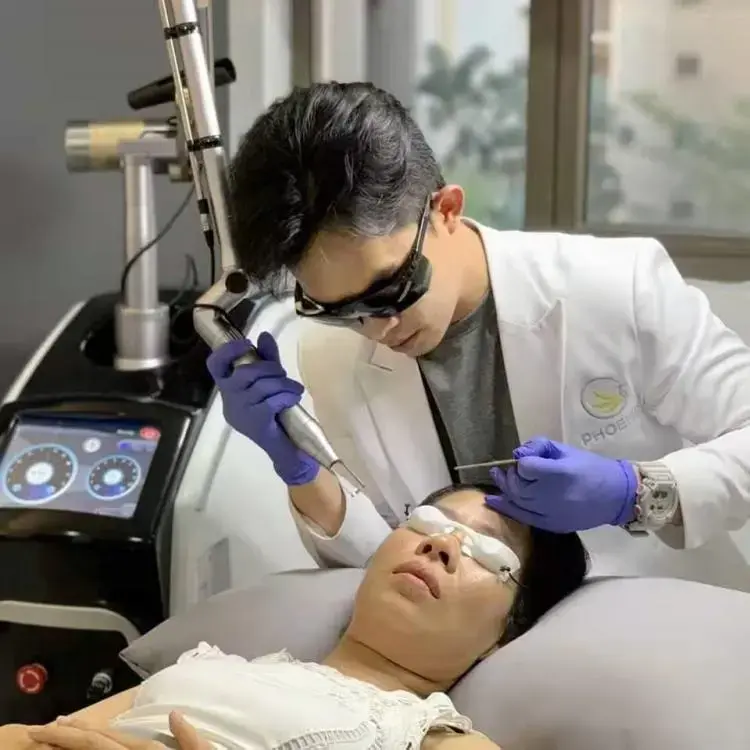
Establishing effective treatment protocols with the 1064 q switched nd yag laser requires comprehensive understanding of pigmentation pathophysiology and laser-tissue interactions. Optimal treatment typically involves a series of sessions spaced four to six weeks apart, allowing sufficient time for the body to clear fragmented pigment particles and for any post-treatment inflammation to resolve completely. During each session, the 1064 q switched nd yag laser is applied using overlapping passes with appropriate fluences determined by skin type and pigmentation density. Practitioners typically begin with conservative energy levels and gradually increase fluence in subsequent sessions based on patient response and tolerance. The endpoint during treatment is typically mild whitening or frosting of the treated area, indicating successful photoacoustic fragmentation of pigment particles. Patients should understand that pigmentation often appears darker immediately following treatment as fragmented particles rise to the skin surface before being eliminated, a process called transient darkening that typically resolves within one to two weeks.
Patient Selection and Pre-Treatment Considerations
Successful outcomes with the 1064 q switched nd yag laser begin with appropriate patient selection and thorough pre-treatment preparation. Ideal candidates include individuals with deep dermal pigmentation, realistic expectations, and commitment to following post-treatment care instructions. Prior to initiating treatment, practitioners should conduct comprehensive skin analysis using tools such as Wood's lamp examination to determine pigmentation depth and distribution. Patients should discontinue photosensitizing medications and avoid sun exposure for at least two weeks before treatment to minimize complications. Those with active skin infections, unrealistic expectations, or contraindications to laser treatment should be counseled about alternative options. Pre-treatment priming with topical agents containing hydroquinone, kojic acid, or tranexamic acid may enhance treatment outcomes by suppressing melanogenesis, though this approach should be customized based on individual patient factors and physician preference. Documentation of baseline photographs and pigmentation assessment scores is essential for tracking treatment progress and demonstrating clinical improvements to patients throughout their treatment journey.
Comparing 1064 Q Switched Nd Yag Laser with Alternative Pigmentation Treatments
When evaluating treatment options for deep pigmentation, the 1064 q switched nd yag laser consistently demonstrates superior efficacy and safety compared to alternative modalities. Traditional treatments such as chemical peels and topical depigmenting agents primarily address superficial epidermal pigmentation and show limited effectiveness for dermal melanosis. Intense pulsed light devices, while useful for superficial pigmentation and vascular lesions, lack the depth of penetration and peak power necessary to effectively fragment deep dermal pigment. Other laser wavelengths, including 532nm and 755nm, may produce good results for epidermal pigmentation but demonstrate inferior outcomes when treating deep dermal lesions due to increased scattering and absorption by superficial melanin. The 1064 q switched nd yag laser uniquely combines deep penetration, selective targeting of melanin, and minimal thermal damage to surrounding tissues, creating an optimal balance of efficacy and safety. Long-term follow-up studies indicate that patients treated with 1064 q switched nd yag laser maintain pigmentation clearance longer than those treated with alternative methods, particularly when combined with appropriate maintenance protocols and sun protection measures.
Conclusion
The 1064 q switched nd yag laser represents the most advanced and effective technology for treating deep pigmentation disorders, offering unparalleled precision, safety across skin types, and superior clinical outcomes compared to alternative treatments. Its unique combination of deep dermal penetration and selective photothermolysis makes it the optimal choice for addressing stubborn pigmentation that resists conventional therapies.
Cooperate With Xi'an Taibo Laser Beauty Company
As a leading China 1064 q switched nd yag laser manufacturer with over fifteen years of production and export experience, Xi'an Taibo Laser Beauty Company offers High Quality 1064 q switched nd yag laser systems at competitive wholesale prices. Our China 1064 q switched nd yag laser factory produces professional-grade equipment exported to more than 180 countries worldwide, backed by comprehensive certifications including CE, ISO13485, and SGS. As a trusted China 1064 q switched nd yag laser supplier, we provide complete OEM/ODM services, two-year warranty coverage, professional training, and 24-hour technical support. Whether you're seeking 1064 q switched nd yag laser for sale for your clinic or establishing distribution partnerships, our experienced team ensures you receive exceptional equipment and service. Discover our competitive 1064 q switched nd yag laser price options and comprehensive support services. Contact us today at susan@taibobeauty.com to discuss your specific requirements and experience why aesthetic professionals worldwide choose Taibo Laser for their pigmentation treatment solutions. Save this article for future reference and reach out whenever you have questions about implementing this transformative technology in your practice.
References
1. Anderson RR, Parrish JA. "Selective Photothermolysis: Precise Microsurgery by Selective Absorption of Pulsed Radiation." Science, Vol. 220, 1983.
2. Chan NP, Ho SG, Shek SY, Yeung CK, Chan HH. "A Case Series of Facial Depigmentation Associated with Low Fluence Q-Switched 1064 nm Nd:YAG Laser for Skin Rejuvenation and Melasma." Lasers in Surgery and Medicine, 2010.
3. Polnikorn N, Tanrattanakorn S, Goldberg DJ. "Treatment of Melasma with the Q-Switched Nd:YAG Laser." Dermatologic Surgery, Vol. 36, 2010.
4. Kono T, Chan HH, Groff WF, Yamaki T, Soejima K, Nozaki M. "Prospective Comparison Study of Narrow-Band UVB and Q-Switched Nd:YAG Laser for Vitiligo." Journal of Dermatological Treatment, 2007.
5. Negishi K, Akita H, Tanaka S, Matsunaga Y, Wakamatsu S, Hattori N. "Comparative Study of Treatment Efficacy and the Incidence of Post-Inflammatory Hyperpigmentation with Different Degrees of Irradiation Using Two Different Quality- Switched Lasers." Lasers in Medical Science, 2013.





YOU MAY LIKE