
Smart Diode Laser Hair Removal for Clinics: Buyer’s Guide
2026-05-04 09:00:35
It can be hard to figure out what to smart diode laser hair removal buy when you're in charge of making decisions that affect your clinic's image and bottom line when it comes to professional hair removal tools. Smart diode laser hair removal is the next step in laser technology. It combines multi-wavelength laser arrays with smart working systems to make treatments safer, faster, and more successful for all skin types. Aesthetic practices have been having trouble with uneven results, long treatment times, the need for operator training, and safety issues for a long time. This technology solves these problems. This guide will tell you everything you need to know to make an investment that will make your patients happier and your business run more smoothly.
Understanding Smart Diode Laser Hair Removal Technology
How Smart Diode Systems Work
Diode laser hair removal works by selective photothermolysis, a process in which certain wavelengths of light target melanin in hair cells without hurting the flesh around them. When laser energy gets into the hair shaft, it turns into heat. This raises the temperature of the root enough to stop hair from growing back. Modern systems use three main wavelengths: 755nm is for lighter skin tones (Fitzpatrick I–III), 808nm is the workhorse wavelength that works for all skin types, and 1064nm is meant to work especially for darker skin tones (Fitzpatrick IV–VI). This multi-wavelength method makes sure that a single device can treat a wide range of conditions.
What Makes Diode Systems "Smart"
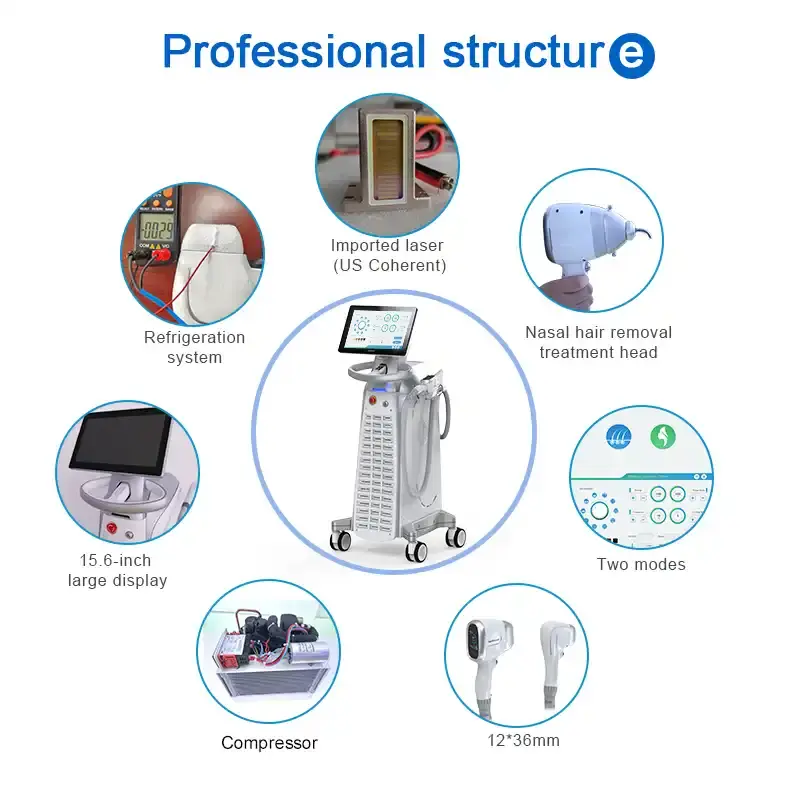
These days, laser devices are smarter than just being automated. Modern units have touchscreens with pre-programmed treatment routines based on skin typing, real-time energy tracking that changes the output during treatment, and built-in cooling systems that keep the patient comfortable while protecting the epidermis. At Xi'an Taibo Laser, our systems use American Coherent laser bars, which are known all over the world for being reliable and long-lasting. They are paired with advanced cooling systems that use water cooling, air flow, semiconductor refrigeration, and TEC technology. Compared to older technologies, this four-layer method keeps the skin at the right temperature during treatments, which makes them much less painful.
Clinical Advantages Over Traditional Methods
Focused laser bands go deeper and more precisely than IPL (Intense Pulsed Light) devices, smart diode laser hair removal, which scatter a wider range of light energy. IPL might need 12 to 15 sessions to show some improvement on certain kinds of skin, but professional diode systems usually show big improvements in 6 to 8 treatments for a wide range of patients. Traditional methods like shaving only work for a short time and can cause ingrown hairs. Electrolysis, on the other hand, is lasting but takes a long time and is very painful. Modern diode systems have a large spot size of 12x36mm, which lets doctors fix big areas like backs or legs in less than 20 minutes. This improves both clinic throughput and patient experience.
Comparing Popular Hair Removal Solutions for Clinics
Diode Laser vs. Alexandrite Laser
When used on fair skin with dark hair, Alexandrite lasers at 755nm give great results quickly thanks to their high repetition rates. But it's clear that they can't help people with darker skin or brown skin because the melanin in their hair and skin competes with it, which can cause burns. This problem is solved by multi-wavelength diode devices. By offering 755nm along with 808nm and 1064nm choices, practitioners can easily treat the whole Fitzpatrick spectrum without having to keep track of multiple devices for each wavelength. This flexibility directly leads to more patients and more money-making opportunities.
Diode Laser vs. IPL Technology
The main difference is between light coherence and precision. It sends out diffuse light over a wide range of wavelengths (usually 650nm to 1064nm), which means that the energy is spread out inefficiently and needs to be carefully filtered to protect the epidermis. This broadband method needs more general energy to get the same results, which can be uncomfortable and increase the risk of side effects. Diode lasers send out coordinated, monochromatic beams with precise frequency aiming, focusing energy right where it's needed. Clinical studies show that diode technology regularly gets rid of more hair with fewer treatments and a lower risk of complications, especially on sensitive areas like the face and waistline.
Long-Term Results Comparison
Patient happiness polls show that outcomes last in very different ways. People who get waxed usually have to come back every 4 to 6 weeks for as long as they want. People who get diode laser treatments, on the other hand, usually finish their treatment classes and only need touch-ups every so often. Electrolysis is theoretically irreversible, but because each follicle has to be treated separately, it takes so much time that many patients give up in the middle of the process. Professional diode systems find the best balance between clinically proven permanence through total follicle death and fair treatment times that patients actually stick to. At Taibo Laser, we promise that our devices will work for at least 50,000,000 shots. This means that your investment in tools will help thousands of patients get better.
Procurement Considerations: Choosing the Right Smart Diode Laser Machine
Critical Technical Specifications
When you're looking at laser systems, wavelength flexibility should be the most important smart diode laser hair removal thing you look at. Single-wavelength devices limit the types of patients you can treat, but triple-wavelength platforms (755/808/1064nm) protect your business from changes in patient demographics. Power output has a direct effect on how fast and effectively treatments work. Our systems range from entry-level 600W units that are good for small offices to high-volume 2000W powerhouses that are made for medical spas. Spot size should be carefully thought out. The 12x36mm treatment window on Taibo systems is the perfect mix between speed and accuracy, allowing full-body treatments without losing facial detail work.
Cooling System Architecture
Managing temperature well is important for both the health and safety of patients. Simple air-cooled systems have trouble keeping the skin at a steady temperature during intense treatments, which can cause burns and force users to use low-energy options that hurt results. Our all-around cooling method uses a number of different technologies. Semiconductor refrigeration controls the base temperature, TEC (thermoelectric cooling) adds exact contact cooling at the skin's surface, and water circulation gets rid of heat buildup in the laser case. This all-in-one system can run continuously at the best settings, so treatment doesn't have to slow down as it does with easier cooling methods.
Certification and Compliance Requirements
In the US, medical gadgets must meet FDA guidelines before they can be used in clinics. CE certification shows that the product meets European standards, and ISO 13485 certification shows that the maker follows medical device quality control systems. These aren't just red tape; they're actual safety tests, electromagnetic compatibility, and consistent production standards that protect your patients and your responsibility. Taibo Laser has up-to-date CE and ISO 13485 certifications, and you can ask for proof of FDA clearance if you want it. Buying certified equipment from well-known companies also makes it easier to deal with insurance companies and pass government checks.
Maintenance, Safety, and Usage Best Practices for Clinics
Routine Maintenance Protocols
Taking good care of your laser will make it last longer. As part of daily routines, the treatment handpiece window should be cleaned with the right optical cleaner (never home glass cleaners, as they leave behind dust that lowers the quality of the beam), the fluid levels in the cooling system should be checked, and the correct start-up diagnostics should be confirmed. Filter cleaning or replacement is done once a week to keep dust from building up in the cooling channels, and the treatment log is looked over to keep track of the number of handpiece shots that are getting close to service intervals. Calibration checks are done once a month to make sure that the energy output stays within the acceptable range. Modern systems, like ours, have built-in diagnostic modes that walk operators through verification steps without the need for extra tools.
Staff Training Requirements
Operator skill has a direct effect on how well patients do and how safe they are. Comprehensive training includes figuring out your skin type using the Fitzpatrick scale, choosing the right parameters for different body parts and hair types, using the handpiece correctly, including the right way to overlap and glide, and recognising bad reactions that need to be fixed right away or the treatment stopped. We give organised training programs with competency goals to make sure that your staff only move from guided practice to working on their own after showing that they can do it safely and consistently. As protocols change and new apps come out, continuing education becomes just as important. Our technical team regularly shares updated protocols and strategies for optimising them with client offices.
Managing Adverse Events
Even when using the right method, problems can still happen and need a quick, correct reaction. Mild redness that lasts for a few hours is a normal reaction that can be treated with cool cloths and gentle lubricants. Itching that doesn't go away or gets worse after 24 hours, blisters, smart diode laser hair removal, or changes in the skin's texture need to be checked out by a doctor right away and written down. For practitioners who are having unexpected reactions, our support team is available 24 hours a day to help them figure out what to do and help them tell the difference between a normal treatment response and a problem that needs to be looked into. Keeping thorough treatment records that include the parameters used, the patient's skin condition, and any reactions that were seen will protect your practice legally and help you learn how to improve your protocols.
Making the Final Decision: Matching Solutions to Clinic Needs
Assessing Your Practice Profile
Small businesses with 10 to 20 hair removal clients a week can benefit from 600-800W systems that offer power without requiring a large initial investment. When compared to more powerful options, these units offer full treatment capabilities with slightly longer treatment times. Mid-sized offices that do 30 to 50 treatments a week should look into 1200W systems that balance speed, capability, and cost. This power level allows for efficient full-body treatments while keeping patient plans flexible. Medical spas that do more than 50 treatments a week need 2000W strong systems that cut down on the time needed for each treatment and increase income per treatment room hour.
Patient Demographics and Market Positioning
Where the equipment is going to be used, and who it is for, determine its best specs. Full multi-wavelength capability is needed for practices in different urban markets to safely treat the wide range of skin tones they'll see. Clinics that see a lot of people with fair skin might choose the 755nm wavelength for faster results on people with lighter skin, while keeping the 808nm and 1064nm choices for patients who are brown or who have skin that changes with the seasons. Value-focused clinics might be willing to put up with a little less comfort in exchange for lower per-treatment costs that allow them to offer competitive prices. Premium practices that put an emphasis on comfort should focus on newer "painless" treatment procedures and advanced cooling systems.
Return on Investment Analysis
Use realistic forecasts to figure out break-even times. A $25,000 diode laser system that makes $150 per session and costs $5 for consumables makes a $145 gross gain. Just five treatments a week bring in an average of $37,700 a year, which covers the cost of the tools in less than eight months. This simple estimate doesn't include the time of the operator or the cost of running the facility, but it shows that professional laser hair removal is generally profitable. A more in-depth study that takes into account actual overhead allocation, financing costs if needed, and expected patient volume growth over the equipment's 7–10 year life span shows the real financial effect. Many businesses get a 200–300% return on their equipment investments in five years, all while building connections with patients that lead to referrals and chances to offer more than one service.
Conclusion
Buying professional laser hair removal equipment, especially systems designed for smart diode laser hair removal, is a big investment that will have long-lasting effects on your business's abilities, image, and ability to make money. Smart diode laser systems use tried-and-true technology to meet real clinical needs, like safe, effective treatment for all skin types, quick procedures that respect both the patient's and the practitioner's time, and reliable performance that boosts the practice's image. You can help your clinic stay successful in this growing market area by carefully comparing technical specs to your practice's needs, putting seller support and equipment quality at the top of your list, and following the right training and maintenance procedures. The technology is no longer just an idea; it is now a well-known treatment that is backed by proof that patients actively seek and that consistently gives them the results they want.
FAQ
1. Is diode laser hair removal safe for all skin types?
When the settings are set correctly, modern multi-wavelength diode devices can safely treat all Fitzpatrick skin types. 755nm is the best wavelength for treating lighter skin tones (types I–III), 808nm is the best wavelength for all skin tones, and 1064nm is the best wavelength for treating darker skin tones (types IV–VI), where lower wavelengths can cause melanin competition problems. For reliable, safe results across a wide range of patient groups, it is still important for operators to have the right training in skin assessment and parameter selection.
2. How many treatments do patients typically require?
Most people get rid of most of their hair permanently after 6 to 8 treatments, spaced out 4 to 6 weeks apart to match the hair growth cycle. Different people have different results depending on the area being treated (hormonal factors often mean that facial hair needs more sessions), the type of hair (coarse, dark hair reacts best), and the patient's hormonal state, among other things. Setting realistic goals during the meeting will help people be happier with the results. Focus on substantial reduction rather than complete removal, and do maintenance treatments on a regular basis to deal with any stubborn or hormonally-influenced regrowth.
3. What maintenance does the equipment require?
Cleaning the treatment handpiece window every day, checking the cooling system filter once a week, and making sure the settings are correct once a month keep the machine running at its best. Professional service every 12 to 18 months, or as recommended by the maker, checks the working of the safety system and fixes any problems with the internal parts. The main part that wears out is the handpiece, which usually needs to be replaced after 50,000,000 pulses, though the exact lifespan depends on the power settings and how the machine is used. With proper upkeep, tools can last for 10 years or more and provide the same level of treatment throughout their lifetime.
Partner with a Trusted Smart Diode Laser Hair Removal Manufacturer
Taibo Laser is ready to help you grow your business with tried-and-true technology and 15 years of manufacturing experience. Our smart diode laser hair removal systems use American Coherent laser bars, advanced cooling technology, and easy-to-understand controls to give you the dependability your reputation needs. We offer full warranties for two years, free technical help at susan@taibobeauty.com, and customisation through our OEM/ODM programs for businesses that need specific branding or setup. Whether you're setting up your first treatment room or growing a business with multiple locations, our team can help you find the right gear for your needs.
References
1. Anderson, R.R., and Parrish, J.A. "Selective Photothermolysis: Precise Microsurgery by Selective Absorption of Pulsed Radiation." Journal of Investigative Dermatology, vol. 77, no. 1, 1983, pp. 13-19.
2. Gold, M.H., and Sensing, W. "Treatment of Unwanted Hair in Ethnic Patients with a Long-Pulse Alexandrite Laser." Dermatologic Surgery, vol. 30, no. 12, 2004, pp. 1497-1501.
3. Haedersdal, M., et al. "Evidence-Based Review of Hair Removal Using Lasers and Light Sources." Journal of the European Academy of Dermatology and Venereology, vol. 25, no. 1, 2011, pp. 9-14.
4. Lanigan, S.W. "Management of Unwanted Hair in Females." Clinical and Experimental Dermatology, vol. 26, no. 8, 2001, pp. 644-647.
5. Ross, E.V., et al. "Comparison of Responses of Tattoos to Picosecond and Nanosecond Q-Switched Neodymium Laser Treatment." Archives of Dermatology, vol. 134, no. 2, 1998, pp. 167-171.
6. Sadick, N.S., and Shaoul, J. "Hair Removal Compared: The Clinical Efficacy of Laser Hair Removal versus IPL Photoepilation." Journal of Cosmetic and Laser Therapy, vol. 6, no. 2, 2004, pp. 83-85.





YOU MAY LIKE