
Portable Fractional CO2 Laser vs Traditional Laser: Which Wins?
2026-04-27 08:57:31
If you compare portable fractional co2 laser systems to traditional tower units, the answer rests on what you need to do in your business. portable fractional co2 lasers work just as well as fixed fractional CO2 lasers at healing acne scars, wrinkles, and discoloration, but they take up less space, can be moved from room to room, and cost less. Traditional lasers have high peak power output and work well in surgery settings with a lot of patients. Portable systems, on the other hand, are the best choice for medspas, dermatology clinics, and multi-site operations that need freedom without losing treatment quality. This is because they are small, have faster ROI, and have features that work together.
Understanding Laser Technologies: Portable Fractional CO2 Laser vs Traditional Laser
The market for aesthetic lasers has changed a lot, giving B2B buyers clear options between standard and portable fractional CO2 laser systems. To make buying choices that support operational goals, it's important to understand these differences.
Core Operating Principles of Fractional CO2 Technology
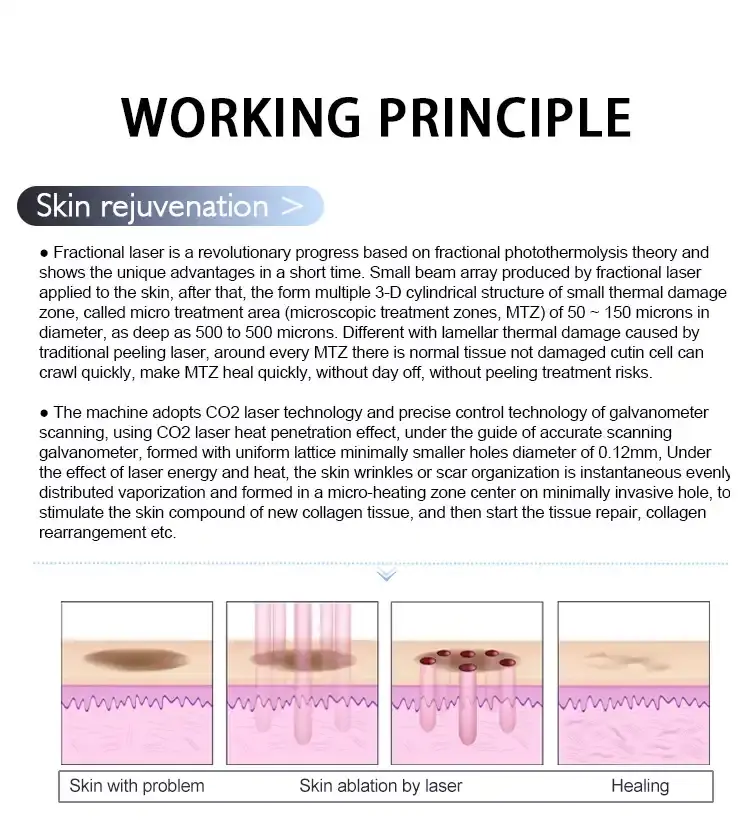
Traditional and portable fractional CO2 laser systems both work at a wavelength of 10,600nm, which targets water molecules in skin tissue to cause controlled heat damage. With fractional technology, the laser beam is split into very small treatment areas (MTZs). These MTZs create very small thermal pathways that go through the dermis without damaging the nearby tissue. This method starts neocollagenesis, which is the body's natural process of making collagen. This makes the skin tighter, scars heal better, and the structure gets better. Because only 15–20% of the treatment area is abated, the mending process goes faster, and there is less downtime than with older full-field ablative ways.
What Defines a Portable System
Portable fractional CO2 laser units use metal tube solid-state laser technology and come in a small tabletop frame that weighs 30–50% less than regular floor-standing models. Modern portable systems have 7-joint flexible light guide arms that keep the output power between 1W and 40W (and often more than 40W in real life). This keeps energy loss to a minimum while the beam is being delivered. Adding closed-circuit water cooling systems makes sure that the machine stays stable during long treatment sessions. This solves the problem of managing heat that early portable designs had. With dot matrix, long pulse, super pulse, and specialized gynecology settings, these devices offer a range of output modes that make treatment more flexible than larger systems. An easy-to-use 10.4-inch touch screen makes it possible for doctors to quickly change settings between patients. The spot size is very exact at ≥0.1mm, which lets you work closely on face features and narrow body parts.
Traditional Laser Systems: Capabilities and Constraints
Traditional CO2 laser platforms, such as ablative Erbium: YAG versions and non-fractional CO2 units, are made up of tall tower consoles that hold bigger laser tubes, power sources, and cooling systems. In the past, these systems were the standard in hospital operating rooms and high-end skin clinics because they were built to last and put out more power all the time (often 50W+). The actual size is usually between 2 and 3 square meters, which includes the range of the articulated arm and the technician's work area. While traditional systems work great for deep cleaning and surgery, the fact that they can't move around makes them hard for offices with more than one treatment room. Professional removal and recalibration are needed to move these units from one place to another, which limits how well the assets can be used. Due to the complexity of the internal parts, maintenance often requires skilled workers, a portable fractional CO2 laser, and longer service intervals. This raises the total cost of ownership over the device's lifetime.
Performance Comparison: Effectiveness and Treatment Outcomes
Not only do specs matter when making a purchase choice, but so do professional success, patient happiness, and operational throughput in the real world.
Efficacy Across Key Treatment Categories
Modern portable fractional co2 laser devices work just as well as older units for most beauty purposes, according to clinical studies. Through controlled dermal restructuring, both technologies successfully treat acne scars, photodamage, fine lines, and hyperpigmentation. Treatment factors like pulse length, density, and flow rate are more important than the shape of the device. Portable systems that use metal tube lasers with specially designed pulse settings (long pulse for coagulation, super pulse for ablation) can deliver enough energy to start fibroblast activity and collagen production up to 4 mm deep.
TB's portable fractional CO2 laser works especially well in:
- Acne Scar Revision: The adjustable spot density lets doctors change the level of treatment, so they can precisely treat rolling, boxcar, and ice-pick scars.
- Periorbital Rejuvenation: The small handpiece and small spot size make it safe to treat crow's feet and loose lower eyelids without too much heat spreading.
- Stretch Mark Improvement: Fractional channels help the skin change shape in striae distensae, which makes the structure and color better over time.
- Vaginal Rejuvenation: Specialized gynecological mode settings make controlled micro-injuries in the vaginal mucosa and muscularis, which help tissues contract and regain their elasticity. This is a new market area where portability makes private treatment room sets possible.
Recovery Timelines and Patient Comfort
Downtime is a very important factor for patient compliance and the ease of office scheduling. Fractional CO2 treatments usually cause redness and slight swelling for 5 to 7 days. After 10 to 14 days, the epithelium completely regenerates. Portable systems that use unique comfort technologies—like improved pulse intervals that let heat escape between micro-ablations—reduce pain during surgery, so normal numbing cream isn't needed as much. Full-ablative CO2 lasers, on the other hand, remove whole epidermal layers, which means that the skin oozes, crusts, and is very uncomfortable to be around for 14 to 21 days. No matter how portable the device is, the fractional method gives patients a better experience that leads to return business and recommendations, which are important for clinics to make money.
Safety Profiles and Risk Mitigation
When used properly, both portable and standard fractional systems have the same risks of complications: temporary hyperpigmentation (which can be controlled with pre- and post-treatment routines), infection (which is very unlikely with proper sterile methods), and redness that lasts for a long time. Portable units that have been certified by CE and ISO 13485 meet strict international safety standards. They make sure that the beam quality is always the same and that there are heat control systems that stop over-treatment. The main safety benefit of portable devices comes from the way they are designed. When operators work long hours, lighter handpieces keep them from getting tired, which lowers the chance of treatment mistakes caused by hand tremors or poor vision. The red aiming beam at 635nm makes it easy to see where to aim, which makes it safer to hit the target and lowers the chance of damaging tissue by accident.
Evaluating Procurement Factors: Cost, Maintenance, and Usability
Businesses need to think about not only the initial prices but also the total value of laser investments over their whole life, which includes upkeep, training, and the ability to change how they work.
Upfront Investment and Long-Term Value
Prices for portable fractional CO2 laser systems range from $8,000 to $25,000, based on the features, the name of the brand, and the accessories that come with the system. Traditional tower units cost between $30,000 and $80,000 because they have a bigger area and are built to hospital standards. The difference in prices makes it easier for new clinics to open and lets established ones spread their money across more than one way to make money. Take treatment cost and patient number into account when figuring out ROI. In the U.S. market, fractional CO2 treatments cost between $500 and $1,500 per session. A portable device that does only 5–10 treatments a month breaks even in 12–18 months. After that, it starts making money on its own. Being able to move the device between different sites speeds up ROI even more by getting the most out of its use.
Maintenance Requirements and After-Sales Support
The total cost of ownership is greatly affected by the costs of upkeep. A simpler design is better for portable systems because it means fewer working parts, which means fewer mechanical failures. The portable fractional CO2 laser from TB comes with a full two-year guarantee that covers all non-consumable parts and includes online diagnostic help and fast parts replacement. The closed water cooling system needs to have its fluids changed on a regular basis, usually every 500 hours of running. This is a simple process that doesn't require any special tools. Traditional units usually need to be taken apart, the lenses cleaned, and the laser tube re-calibrated once a year at the plant. Service contracts can add between $3,000 and $6,000 a year to the cost of doing business. The global service network is very important. TB works in more than 180 countries with local distributor support, making sure that problems are fixed quickly and that downtime that hurts income is kept to a minimum.
Usability and Clinic Integration
Operational ease directly affects how quickly staff can do their jobs and how many patients can be seen. Portable fractional CO2 laser devices work perfectly with the way treatments are already done. The 10.4-inch touchscreen display has easy-to-use settings for changing the design density, pulse mode, and power. Pre-programmed treatment methods for common conditions like acne scars, photoaging, and reproductive issues cut down on setup time and make sure that results are the same for all practitioners. Mobility is a huge edge that can change the game. Clinics can put the device in any treatment room that has space, so patients don't have to waste time going to a separate laser suite. Standard vehicles can easily carry equipment that is useful for mobile clinics that serve rural areas or business wellness programs. When fixing the face or doing gynecological treatments, the 7-joint articulated arm's 360-degree range of motion makes it easy to use.
Making the Right Choice: Market Trends and Buyer Considerations
When making procurement portable fractional CO2 laser plans, you need to think about how the market is changing, how the competition is doing, and what your target patient population needs.
Current Market Leaders and Technology Differentiators
The portable fractional CO2 laser market has grown very quickly. Companies like TB have used their 15 years of research and development and production experience to make devices more reliable. TB has been around since 2009 and runs its own factory, foreign sales infrastructure, and after-sales service teams. This is called "vertical integration," and it makes sure that quality control and quick help are met. In contrast, names that outsource manufacturing often end up with uneven build quality and service that is hard to get. One of TB's competitive advantages is that its actual power output is higher than the rated specifications (>40W, even though the label says 1-40W), which means that it can deliver enough energy even as laser tubes age. The metal tube solid-state laser design lasts longer than glass tube options, which lowers the cost of replacement over time. Certification compliance (CE, ISO 13485) gives buyers seeking controlled markets peace of mind, and continued FDA certification efforts show dedication to accessing the North American market.
Technical Comparisons: CO2 vs Erbium Fractional Systems
People who are buying lasers sometimes look at fractional CO2 lasers and Erbium: YAG options. Erbium lasers (with a wavelength of 2940nm) can go deeper into the skin and help it heal faster, but they can't change collagen in the deep dermis as deeply as needed for major scar repair and reshaping. CO2 devices are better for mild to severe photoaging and textural flaws because they resurface more aggressively. The choice depends on the type of patient—Erbium works best for practices that focus on care, while CO2 systems are better for practices that want to change patients' lives. Portable fractional CO2 laser systems give you the therapeutic power of CO2 technology without the space and cost issues that come with traditional systems.
Procurement Strategies for Informed Decisions
For buying to go well, you need to do more than just look at the information sheets. Spending money on things like throwaway handpiece covers and cooling fluid, staff training, and marketing portable fractional CO2 laser campaigns to get patients' attention should all be included in the budget. Volume purchasing programs, which are often offered to clinic groups or sellers with multiple locations, can cut costs by 15 to 25 percent per unit, making the initial investment more useful. Flexibility of the supplier is very important. Look at how much a company can make, how much experience they have with exporting, and how many global marketing networks they already have. TB's position in more than 180 countries shows that it is good at both logistics and legal navigation.
Case Studies & Verification: Real-World Applications and Outcomes
Evidence-based buying choices are based on performance data collected across a wide range of clinical situations and patient groups.
Multi-Site Clinic Deployment Success
A medspa chain with five sites in the southwestern US bought TB portable fractional CO2 laser devices in 2022 to fix problems with their old laser suite that were limiting their ability to do more work. Within six months, the procurement manager said that treatment rooms were being used 40% more. He said that this was possible because devices could be moved between sites based on daily booking trends. Patient happiness scores stayed the same as they were at their old tower unit, and running costs went down because repair contracts were consolidated and technicians didn't have to travel as much. Because the chain was mobile, it could also give mobile services at workplace wellness events, which brought in an extra $45,000 during the pilot year. Diversification like this would not have been possible with fixed old methods, showing how portable tools open up new business models.
Dermatology Practice Feedback on Treatment Versatility
In 2023, a board-certified dermatologist in New York added a TB portable fractional CO2 laser that was made just for combination treatments. The doctor uses platelet-rich plasma (PRP) treatments along with fractional CO2 resurfacing to improve scar repair. The ultra-pulse mode of the device creates microchannels that make it easier for the PRP to absorb. Clinical photography showed that the combination of fractional CO2 and photography reduced scar volume 30–50% more than CO2 alone. This enhanced the practice's image for handling difficult cases. The dermatologist highlighted usability: "The touchscreen interface allows me to adjust settings between patients without breaking the sterile field.
Clinical Study Evidence and Safety Data
Peer-reviewed research backs up the effectiveness of fractional CO2 in a variety of settings. The Journal of Cosmetic and Laser Therapy released a study in 2021 that looked at 120 people who had fractional CO2 treatment for acne scars. The study found that the scars got 60% better after three sessions, which were spaced eight weeks apart. Complication rates stayed below 5%, mostly temporary post-inflammatory discoloration in darker skin types (Fitzpatrick IV–VI), which could be controlled with hydroquinone and broad-spectrum sunscreen. Safety information from device registers in European markets shows that fractional CO2 systems that meet CE approval standards keep the beam quality and temperature stable, so there isn't much risk of burns even during long sessions.
Conclusion
Your clinic's business goals, space limitations, and growth plan will help you decide between portable fractional CO2 laser systems and traditional platforms. Portable units give clinical results that are similar to tower systems, but they are much easier to move, take up less room, and protect capital. Traditional lasers are still useful in high-volume surgery settings that need maximum continuous power output, but portable technology is better for most cosmetic practices because it is more flexible and costs less overall. TB's portable fractional CO2 laser is a good example of this change. It has a metal tube that is reliable, can work in multiple modes, and has been certified to meet international legal standards. It also comes in a form factor that works with modern clinic processes and new business models.
FAQ
1. How does a portable fractional CO2 laser compare technologically to traditional systems?
In terms of technology, how does a compact portable fractional CO2 laser stack up against older systems? Portable fractional CO2 lasers use the same 10,600nm range and fractional delivery principles as regular lasers, but they put all of their parts into a small desktop case. Modern portable systems use solid-state lasers with metal tubes and 7-joint flexible arms. These systems have the same power output (1-40W+) and beam accuracy while taking up 50–60% less space. Traditional methods can provide more power continuously, but they are less mobile and need bigger areas.
2. What maintenance does a portable CO2 fractional laser require?
Replacement of the cooling system fluid (every 500 hours of operation), cleaning of the external glasses with alcohol-free lens solution, and checking the handpiece for wear are all part of routine upkeep. The portable fractional CO2 laser from TB comes with a two-year guarantee that covers all parts except for consumables. The warranty also covers remote troubleshooting and faster shipping of parts. Traditional systems need to be serviced once a year at the plant, but portable units cut down on upkeep costs and downtime by a large amount.
3. Are portable CO2 lasers certified for international markets?
Portable fractional CO2 lasers made by reputable companies have CE and ISO 13485 certifications, which show that they meet European and foreign standards for medical devices. These rules are met by TB's gadgets, which means they can be used legally in major global markets. Buyers should make sure that the certifications are valid in the areas they want to sell to and that the makers provide the compliance paperwork needed for clinical use and importation. This way, buyers can avoid regulatory issues that slow down revenue generation.
Partner with TB for Your Portable Fractional CO2 Laser Needs
Selecting the right portable fractional CO2 laser provider affects not only how well the equipment works but also how well your business does in the long run. TB is a committed producer with more than 15 years of experience making and exporting medical equipment. They offer CE and ISO 13485-certified systems that are built to be reliable and useful in a variety of clinical settings. Our metal tube solid-state lasers produce more power than what was specified, so the results will stay the same for the whole life of the device. Every unit comes with a full two-year warranty, professional help 24 hours a day, seven days a week, and access to our global service network, which covers more than 180 countries.
We know that business-to-business buyers need more than just tools. They also need relationships that help their businesses grow. TB offers OEM/ODM customization, savings for buying in bulk, and free training on-site for orders of more than one unit. Our team makes solutions that fit your needs, whether you run a single clinic or are in charge of marketing routes in multiple areas. Get in touch with susan@taibobeauty.com right away to get full specs, set up factory tours, or talk about bulk prices for partnerships with portable fractional CO2 laser manufacturers. You should get tools and help for the investment that gives you a clear return. Let TB show you why top clinics choose our technology for their aesthetic laser portfolios.
References
1. Anderson, R.R., & Parrish, J.A. (1983). Selective photothermolysis: precise microsurgery by selective absorption of pulsed radiation. Science, 220(4596), 524-527.
2. Manstein, D., et al. (2004). Fractional photothermolysis: a new concept for cutaneous remodeling using microscopic patterns of thermal injury. Lasers in Surgery and Medicine, 34(5), 426-438.
3. Hantash, B.M., et al. (2007). Bipolar fractional radiofrequency treatment induces neoelastogenesis and neocollagenesis. Lasers in Surgery and Medicine, 39(1), 1-9.
4. Tierney, E.P., & Kouba, D.J. (2011). Fractional CO2 laser treatment of photoaging: prospective study in 45 patients and review of the literature. Journal of Drugs in Dermatology, 10(11), 1303-1310.
5. Chapas, A.M., et al. (2008). Successful treatment of acneiform scarring with CO2 ablative fractional resurfacing. Lasers in Surgery and Medicine, 40(6), 381-386.
6. Alexiades-Armenakas, M., et al. (2008). Fractional laser resurfacing as a novel therapeutic modality for steroid-induced iatrogenic glaucoma and limbal stem cell deficiency. JAMA Dermatology, 144(8), 1030-1033.





YOU MAY LIKE