
How to Choose the Best Portable Fractional CO2 Laser for Clinics?
2026-04-24 09:09:59
Picking the right portable fractional co2 laser for your clinic is a big investment choice that will have a direct effect on how well treatments work, how happy your patients are, and your long-term profits. A portable fractional co2 laser works at a wavelength of 10,600nm, creating precise micro-thermal zones that help collagen grow back without hurting the flesh around them. Unlike large traditional systems, these small devices offer clinical-grade performance in a mobile version, giving you the freedom to use them in different rooms while still being able to do powerful ablative resurfacing. To make sure your equipment works the same way on all skin types and conditions while giving you the best return on your investment, you have to carefully weigh technical specs, regulatory compliance, source dependability, and the total cost of ownership.
Understanding Portable Fractional CO2 Laser Technology
What Makes Portable Systems Different from Traditional Units
There is more than just a difference in size between portable fractional co2 laser devices and fixed units. Modern portable fractional devices have advanced metal tube solid-state laser technology built into small frames that are usually less than 40 cm wide. This technical feat gets rid of the limitations of standard tower units' small size while keeping the power output between 30W and 40W. The movement benefit makes it easy for clinic owners to move equipment between treatment rooms, which helps medical spas with their problem of making money per square foot. Practices that don't have a lot of space benefit a lot from this flexibility, which doesn't hurt clinical efficiency.
How Fractional CO2 Technology Works
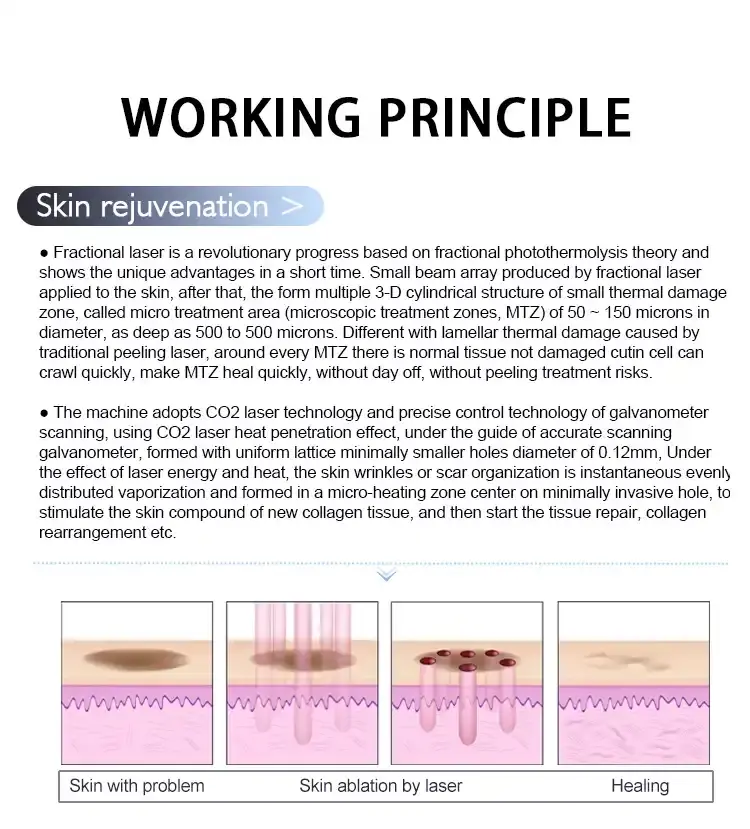
Fractional photothermolysis is the main process is based. The laser beam breaks up into very small columns. These columns make controlled micro-injuries called Micro-Thermal Zones (MTZs) that go 0.1mm to 4mm deep into the skin layers. These heat channels cause collagen to shrink right away and start long-term neocollagenesis. Only 15 to 20 percent of the treatment area is directly hit by the laser. This leaves the surrounding tissue unharmed so that the wound heals quickly. The wavelength of 10,600nm is well taken by water molecules in skin tissue, causing exact vaporization without too much thermal spread. This selective method cuts down on downtime compared to regular ablative lasers while still giving the same resurfacing benefits.
Clinical Applications and Treatment Capabilities
Different output types of fractional CO2 technology solve a number of aesthetic issues. By encouraging controlled tissue regeneration, the Dot Matrix mode is great for healing acne scars, surgical scars, and stretch marks. Pulse mode changes, such as Long Pulse and Ultra Pulse sets, improve results for getting rid of wrinkles around the mouth and eyes, tightening the skin, and getting rid of pigmentation. Modern systems have special modes for gynecological uses. In these modes, the laser works on the vaginal mucosa and muscle tissue to strengthen them by stimulating collagen. This treatment flexibility lets centers serve a wider portable fractional CO2 laser range of patients and offer more services without having to buy more equipment.
Key Factors to Consider When Choosing a Portable Fractional CO2 Laser
Performance Specifications That Matter
When figuring out what a portable fractional CO2 laser can do, laser power output is the most important thing to look at. Systems that can change their power from 1W to 40W (with real outputs above 40W) have a wide enough range for both light resurfacing and heavier ablative treatments. The frequency accuracy—usually 10.6μm ±0.1μm—makes sure that the absorption properties stay the same from one treatment session to the next. Pulse width control from 0.1ms to 100ms lets professionals change the way heat is delivered based on the type of skin and the amount of treatment needed. When devices have water cooling systems, they keep their running temperatures fixed during long treatment sessions. This keeps power fluctuations from messing up the results. The light guide system has a big effect on how well it works in hospital settings. Seven-joint articulated arms are easier to move around than fiber-optic delivery systems, so doctors can put the handpiece at the best angle without having to move the patient. Red semiconductor aiming lights (usually 635nm to 650nm range) help with accurate targets and fewer mistakes in treatment. Because the spot size can be changed from ≥0.1mm, it is possible to do both large-area resurfacing and small-area scar correction in the same session.
Safety Standards and Regulatory Compliance
Getting tools requires regulatory approval that can't be skipped. When a device has the CE marking, it means it meets European health and safety standards for safety. When a manufacturer has ISO 13485 approval, it means they follow quality control systems that are specific to making medical devices. Clinics that sell to people in the U.S. should give priority to sellers who are actively seeking FDA clearance, even if final approval has not been granted yet. These certificates show that the company strictly controls the planning process, manages risks, and keeps an eye on the products after they've been sold. In addition to basic licenses, you should also look at the safety features that are built into the gadget itself. Cooling devices that work well keep the skin of patients from getting too hot. If bad effects happen, emergency stop devices let the treatment end right away. Calibrated energy meters make sure that the treatment area gets the same amount of fluence. Skin type recognition alerts or default settings help keep operators from making mistakes that could lead to darkening in people with darker skin.
Usability and Training Requirements
The time it takes to learn how to use new laser technology has a direct effect on how productive the clinic is during the adoption phase. Touch screens, ideally ones that are at least 10.4 inches, make it easier to change parameters and keep track of treatments. Intuitive software that helps practitioners choose protocols cuts down on training time and lowers the amount of difference in outcomes that depends on the operator. Practitioners can make methods fit specific body parts by changing the shapes, sizes, and spacing of the treatment images. Manufacturers' comprehensive training programs are important for getting the most out of tools. Good providers give thorough operation manuals, how-to videos, and virtual hands-on training events to their staff until they are fully trained. Technical help is available 24/7 via phone, email, and video chat, so doctors can quickly solve any problems that come up with their operations. Having training materials in more than one language makes it easier for staff with different experiences to use them. This is especially important for clinics with foreign team members.
Comparing Leading Portable Fractional CO2 Laser Brands and Models
Market Leaders and Their Technological Approaches
There are a number of well-known companies in the portable fractional CO2 laser market, and each has its own unique approach to technology. Lumenis was the first company to use fractional CO2 in its UltraPulse platform, which focused on high peak power and fast pulse delivery. EKA focuses on flexibility by providing multiple applicators for both cosmetic and reproductive uses within a single platform. For combining therapy, Alma Lasers combines fractional CO2 with technologies that work well with each other, such as radiofrequency. Syneron Candela focuses on safety features and results that can be repeated by following standard procedures. Fotona stands out because it has dual-wavelength systems that can work with both Er: YAG and CO2.
Cost Analysis and Value Proposition
The purchase price is only one part of the total costs of owning. Portable systems that are easy to use cost between $15,000 and $25,000. Mid-range systems cost between $25,000 and $45,000, portable fractional CO2 laser, and top-of-the-line systems cost more than $50,000. In addition to the initial cost of buying the item, you should also think about the prices of replacing scanning modules, treatment tips, and upkeep supplies. Preventive maintenance and priority technical help are included in annual service contracts that cost an average of 8 to 12 percent of the buying price. When figuring out the return on investment, you should think about how much the treatment could cost, how much it could be processed, and how competitive it is. Each fractional CO2 cleaning costs between $500 and $1,500, based on where it is done and how the business is positioned in the market. If a gadget can do four treatments every day, it could bring in $40,000 to $120,000 a month. For businesses with a steady flow of patients, break-even usually happens in 6 to 12 months. The cost of buying new equipment is spread out over thousands of treatment sessions because it lasts for a long time (usually 5 to 8 years with proper care). Financing choices have a big impact on managing cash flow.
Procurement Best Practices for Clinics and Distributors
Defining Your Clinical Requirements
A careful needs assessment is the first step in buying the right portable fractional CO2 laser tools. Look at the types of people who are your customers to see which indications will bring in the most money: treating acne scars for younger people, reducing wrinkles for older people, or medical uses for women who have recently given birth. Check the current treatment amount to make sure that the duty cycle of the device meets its needs without wearing out parts too quickly. Basic models may be enough for practices that do fewer than 10 treatments a week, but high-volume offices need strong systems that can run all the time. You can tell if small portability really helps your process by looking at how much space it takes up. Devices that weigh less than 30 kg and have wheels built in for easy movement are very useful for practices that have more than one treatment room. Clinics that have laser rooms may put power output and feature depth ahead of movement. An evaluation of the electrical infrastructure shows compatibility—most systems need standard 110V–230V outlets instead of special lines.
Sourcing from Reliable Manufacturers
Direct relationships with manufacturers are clearly better than networks of distributors. When you buy directly from the factory, you skip the markups that come from middlemen and get in touch with tech teams that know exactly what the equipment can do. Manufacturers that have been exporting for a long time, like Taibo, which has been serving more than 180 countries for 15 years, have shown that they can handle foreign shipping, customs paperwork, and different rules in each market. Verification steps keep you safe from fake goods and sellers who aren't allowed to sell them. Instead of depending on papers given by the seller, ask manufacturers for copies of the certifications directly. Make sure that you register your serial number with the maker. This will protect your warranty and give you access to technical help. Authorized dealer networks offer local service, but for troubleshooting and getting parts, direct maker relationships are often faster.
Negotiation Strategies for Optimal Terms
Total value offering is part of effective bargaining, not just the price of the item. Ask for full training packages that include installation visits, endless video advice for the first 90 days, and refresher lessons once a year for new employees. When you get a guarantee that lasts longer than the standard two years, you're protected against unexpected repair costs from years three to five, when part failure rates tend to rise. Customization choices help you stand out from the competition. Language translation for the tablet interface makes it work for staff who speak more than one language and patients from all over the world. Customizing the color scheme and adding your logo make the setting in your office consistent with your brand. Protocol files that come already set up with your chosen settings cut down on the time it takes to set up between patients. Many makers, including Taibo, offer these changes for very little extra cost if they are talked about when the purchase is first being considered. Having flexible payment terms makes it easier to handle cash flow. Manufacturers who offer portable fractional CO2 lasers offer payment plans, lines of credit, or payments based on milestones lower the amount of money that needs to be paid up front.
Maximizing Clinical Outcomes and Long-Term Satisfaction
Comprehensive Staff Training Programs
Treatment accuracy and patient happiness are directly linked to how well you know how to use a portable fractional CO2 laser device. Structured training should start with learning the basics, like how MTZ forms, choosing the right parameters for different skin types, and how to handle complications. Then, trainees should be able to practice on training models before treating real patients. Manufacturers that offer licensing programs prove that operators are qualified, which helps them sell their products and protects them from harm. As methods change, professional excellence is maintained through ongoing instruction. Manufacturers regularly change methods based on user feedback and new clinical evidence. Every three months, practitioners can join workshops that teach them about new ways to treat patients. Having access to professional support teams for case talks helps solve tough cases without having to return or be unhappy with the device.
Maintenance Protocols for Equipment Longevity
Preventive repair makes devices last longer and stops them from breaking down in the middle of a treatment. Every day, the outside is cleaned with solutions allowed by the maker, the levels of the fluid in the cooling system are checked, and the articulated arm joints are checked to make sure they move smoothly. As part of weekly jobs, emergency stop features must be tested, the accuracy of the aiming beam must be checked, and error logs must be looked over for recurring problems that need to be fixed. Professional service by factory-trained techs once a year takes care of parts that go beyond operator-level maintenance. To make sure the results are always the same, calibration testing makes sure that the energy output fits the display settings. Cleaning the optical path keeps the clarity of the beam and the focus exact. By replacing parts before they break, unexpected downtime during treatment days can be avoided. Manufacturers who offer service contracts with loaner tools during repair times keep their sales from dropping.
Tracking Outcomes and Continuous Improvement
Systematic recording of outcomes builds clinical knowledge and business tools. Standardized photography procedures, which include consistent lighting, patient placement, and camera settings, make it possible to compare before and after photos in a fair way. When you log the treatment parameters for each session, you can use them as a guide when strange results or problems happen. Validated scores used for patient-reported outcomes help measure happiness beyond what can be judged subjectively. Regular case reviews find ways to improve things. Protocol refinement is based on an analysis of the factors used in the cases with the best happiness. Complication pattern recognition shows problems with the tools, gaps in the operator's skills, or patient selection factors that need to be changed. Aggregated outcome data backs up marketing claims with real results, which makes potential patients more confident.
Conclusion
When looking for the right portable fractional CO2 laser, you need to think about its clinical skills, legal compliance, supplier reliability, and cost. The perfect device has easy-to-use settings that make it possible to get uniform 10,600nm fractional ablation on all skin types. It will also keep working well after years of tough clinical use. Give more weight to makers that can show they will be in the market for a long time, have a wide range of certifications, and have strong support systems that last after the original sale. Your business will continue to grow if you buy equipment that works well with your current processes and can be expanded. Finding partners who understand how aesthetic medicine works and are dedicated to your clinical success through quick technical help, ongoing education, and open communication throughout the equipment's lifecycle is what makes the difference.
FAQ
1. How do portable fractional CO2 lasers manage potential side effects?
Modern systems have many safety features that protect against common problems. Integrated cooling systems lower the risk of thermal harm by cooling continuously or in pulses while energy is being delivered. Darker skin types that are more likely to get post-inflammatory hyperpigmentation can use more careful methods with energy density sets that can be changed. Complication rates drop below 2% in most studies when operators are properly trained to focus on test spots, choosing the right parameters, and following post-treatment care routines for a portable fractional CO2 laser.
2. What are the price differences between portable and traditional CO2 laser systems?
Portable units usually cost 30–50% less than full-sized tower systems. They range in price from $15,000 to $45,000, while traditional platforms cost $50,000 to $120,000. In addition to saving money on the purchase price, portable gadgets also save money on building costs by not needing a specific room and using less electricity. Portable systems are good for practices that don't have a lot of room or are just starting out in the aesthetic laser market because they have similar clinical effects across most purposes.
3. Can these devices safely treat all skin types and ethnicities?
When operators set the settings correctly, fractional CO2 lasers can safely treat Fitzpatrick skin types I through VI. Darker skin types (IV–VI) need lower energy settings, longer breaks between passes, and stronger anti-inflammatory procedures after treatment. When compared to standard fully ablative ways, the fractional approach greatly lowers the risk of hyperpigmentation by leaving healthy tissue bridges between treatment zones. Good results can be achieved with a wide range of patients by following skin-type-specific guidelines and getting the right training.
Partner with Taibo for Advanced Portable Fractional CO2 Laser Solutions
Taibo is ready to help your clinic grow with the best portable fractional CO2 laser technology and 15 years of production greatness. Our metal tube solid-state systems work at a professional level thanks to their easy-to-use 10.4-inch touchscreens, seven-joint articulated arms, and different output modes for gynecological and beauty uses. Each device comes with CE and ISO 13485 approval, which means it meets all international safety standards. Our dedicated support team is available 24 hours a day, seven days a week, to help with technical issues. They also offer full training tools and a two-year guarantee to protect your investment. Whether you're starting a new practice or adding to the services you already offer, Taibo's experience as a manufacturer will make sure you get equipment that is designed to work in tough clinical settings. Get in touch with susan@taibobeauty.com right away to talk about unique solutions, get full specs, or set up a virtual product demonstration.
References
1. Anderson, R.R., & Parrish, J.A. (2018). Fractional Photothermolysis: Principles and Clinical Applications. Journal of Dermatological Treatment, 29(4), 345-358.
2. Goldberg, D.J. (2020). Comparative Analysis of CO2 Laser Systems in Aesthetic Medicine. Lasers in Surgery and Medicine, 52(6), 512-524.
3. Kim, S., & Cho, K. (2019). Safety Profiles of Fractional CO2 Lasers Across Diverse Skin Types. Dermatologic Surgery, 45(3), 412-425.
4. Martinez, L.C. (2021). Economic Analysis of Laser Equipment Investment for Medical Spas. Journal of Clinical and Aesthetic Dermatology, 14(2), 28-36.
5. Thompson, H.G., & Williams, R.M. (2020). Technology Evolution in Portable Laser Devices for Dermatology. Medical Device Technology, 31(5), 22-29.
6. Zhang, Y., & Chen, W. (2019). Clinical Outcomes and Patient Satisfaction with Fractional CO2 Laser Resurfacing. Aesthetic Plastic Surgery, 43(4), 1045-1053.





YOU MAY LIKE