
Portable 808nm Diode Laser Hair Removal: Buyer’s Guide 2026
2026-05-05 09:02:48
Getting the right laser hair removal tools can change the services your business offers and the amount of money it can make. portable 808nm diode laser hair removal is the best professional hair removal technology. It is a small, clinically portable 808nm diode laser hair removal device that works on all skin and hair types and gives lasting results. As procurement managers and beauty business owners think about what tools to buy in 2026, it's important to know about the technical specs, legal requirements, and operational benefits of these systems. This complete guide looks at everything from basic technology concepts to new technologies that are just coming out. It will help you make smart buying choices that are in line with your business goals and your customers' standards.
Understanding Portable 808nm Diode Laser Hair Removal Technology
How 808nm Wavelength Technology Works
Selective photothermolysis is the science behind diode laser hair removal. This is an exact process in which laser energy targets melanin in hair cells. The 808nm frequency goes deep into the dermis and reaches the stem cells that live in the follicle's bulb and bulge. Melanin captures this particular wavelength of light and turns it into heat, reaching temperatures of 65°C to 70°C. This thermal damage stops the follicle from repairing itself, but it protects the nearby tissue with a controlled energy supply and built-in cooling systems.
Technical Specifications That Define Quality
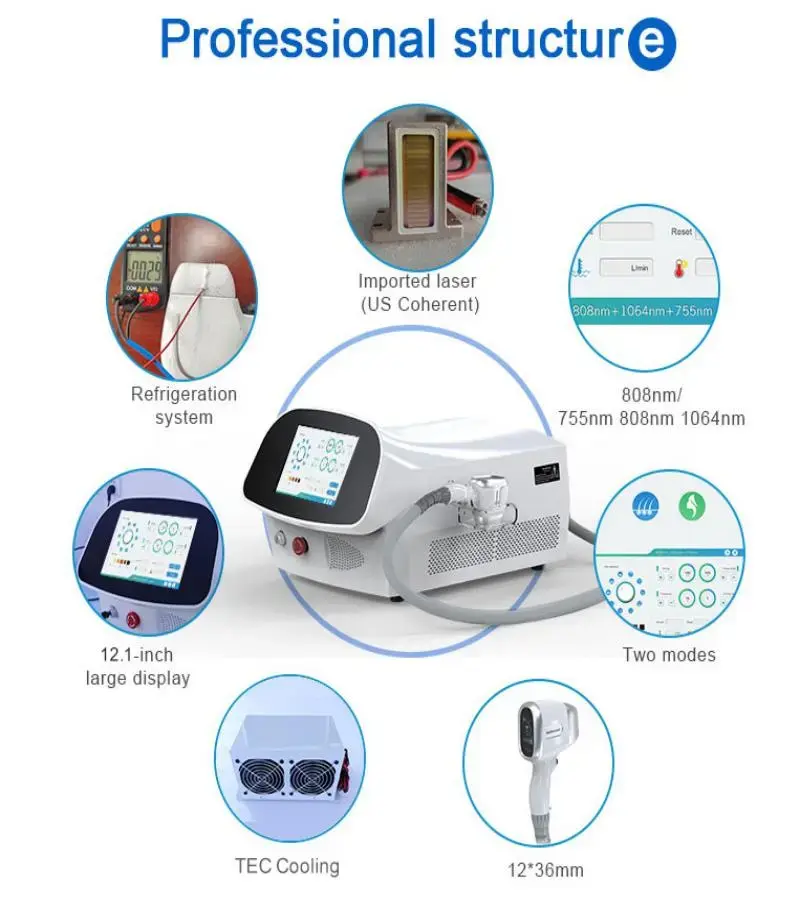
Modern portable systems can now combine different wavelengths, with 808nm being the main wavelength and 755nm and 1064nm being added for different skin tones and lighter blonde hair. Our systems offer laser power ranging from 600W to 2000W, which means that all kinds of Fitzpatrick skin can be treated. The 12x36mm spot size strikes a good mix between treatment speed and energy concentration. This lets therapists cover big parts of the body quickly while keeping therapeutic fluence levels between 10 and 120 J/cm². With a frequency range of 1 to 10 Hz, it's possible to adapt to different treatment plans and client comfort levels.
Safety Architecture and Cooling Systems
Modern compact diode lasers have many safety features that set professional-grade tools apart from consumer devices. The cooling system uses water cooling, semiconductor refrigeration, air flow, and thermoelectric cooling (TEC) to keep the handpiece at the right temperature for long treatment sessions. Contact cooling temperatures as low as -5°C can be reached with this method. This numbs the epidermis and saves the top layer of skin while thermal energy kills the hair follicles below. The systems stay stable for 72 hours straight, so they can handle high-volume clinic processes without slowing down. Two-level safety locks keep the machine from being turned on by mistake, and real-time LCD handle portable 808nm diode laser hair removal displays show working factors to keep the operator informed and treatment consistent.
Comparing Portable 808nm Diode Laser Devices to Other Hair Removal Methods
Diode Laser Versus Alexandrite Systems
Alexandrite lasers work at 755nm, which makes them very good for people with lighter skin and fine hair. But because of higher melanin absorption in the epidermis, their shorter range makes them unsafe for people with darker skin. When applied to brown or naturally darker skin, the 808nm diode frequency goes deeper and is less likely to burn because it absorbs less of the epidermis. From a purchasing point of view, diode devices can be used in more markets, which is especially helpful for clinics that serve a wide range of areas. The amount of pain during treatment stays about the same, though newer diode units with improved contact cooling often offer better comfort.
Diode Technology Compared to Nd: YAG Lasers
For very dark skin (Fitzpatrick V–VI), Nd: YAG systems with 1064nm wavelengths are the best choice because they don't hit epidermal melanin as much. In exchange, the follicle can't absorb as much melanin, so bigger fluences and more treatment sessions are needed to get a lasting reduction. With the right parameter adjustments, the 808nm diode hits a good mix between being safe for skin types I through V and needing fewer sessions than Nd: YAG treatments. The 808nm wavelength gives businesses the best cost-per-result rates for major areas where skin types II–IV are common.
IPL Devices and At-Home Solutions
In IPL technology, flashlamps that are filtered send out light at various colors at the same time. This light doesn't stick together, so it spreads more easily and needs more energy overall while being less specific to hair follicles. Treatment effectiveness varies a lot, and usually needs 30–50% more sessions than diode lasers. Due to safety rules, at-home devices that use IPL or low-power diodes can only be used for maintenance after professional treatments because they work at much lower energy levels (usually less than 5 J/cm²). Professional portable 808nm diode laser hair removal lasers get clinical-grade results in fewer meetings. This makes clients happier and increases long-term income per client.
Procurement Considerations for Portable 808nm Diode Laser Hair Removal Devices
Critical Device Specifications to Evaluate
When looking at offers from suppliers, certain technical factors decide how well and how long something will last in the real world. The location of the laser bar has a big effect on how reliable it is. Systems that use American Coherent or German Jenoptik diode stacks keep the energy stable within ±5% variation for the 20 million pulses that the handpiece is designed to last. Bars of lower quality may break down by 15 to 20 percent every year, needing to be replaced too soon. Check the actual optical power output instead of the electricity input; a system that says it has 1200W of power should actually have about 800–900W of optical power at the treatment opening. Duty cycle is based on the cooling system's capacity—can the device run constantly during back-to-back appointments, or does it need breaks to cool down, which limits the daily throughput? Ask for specific information on how the pulse width can be changed (ideally within a range of 10–400ms) so that the thermal relaxing time can be adjusted for different hair diameters and lengths. The spot size affects both the speed of the treatment and the regularity of the energy delivery. For body treatments, bigger spots (12x20mm or more) are more efficient, while smaller spots allow for more precise treatments on the face. Lastly, look at how advanced the user interface is. For example, a 12-inch touchscreen with pre-set routines makes training staff easier and cuts down on operator mistakes compared to simple button controls.
Regulatory Compliance and Certification Requirements
In the US, using lasers means following the portable 808nm diode laser hair removal rules set by the FDA in 21 CFR 1040.10 and 1040.11, which are called "laser product performance standards." Even though the FDA doesn't "approve" beauty lasers, the agencies that make them have to be registered with the FDA and meet certain government standards. More solid proof comes from the FDA 510(k) clearance for certain uses, like lifelong hair loss, which shows that the device is substantially equivalent to legally sold devices that are similar. For this clearance, you need to send in clinical data, which is especially important if you're selling results to clients. It is also very important for foreign sales that the medical device meets European safety and performance standards, which is shown by CE approval under the Medical Device Regulation (MDR 2017/745). If you want to be sure that treatment claims are true, look for Medical CE (Class IIa or IIb) instead of general CE marks. ISO 13485 approval shows that the company makes and uses quality management systems that are specific to medical devices. These systems cover design controls, production processes, and monitoring after the products have been sold. When judging providers, get certificates straight from the organizations that are supposed to give them and check the registration numbers in official databases. Taibo Laser Beauty has both CE and ISO 13485 certifications, and FDA approval is currently being processed. This makes sure that our devices meet the standards for medical products around the world.
Supplier Credibility and After-Sales Support
Your relationship with the company that sells you tools goes far beyond the buy itself. Factory surveys or third-party inspection services are good ways to check a manufacturer's qualifications. Reputable manufacturers should welcome openness. Companies that have been in business for 15 years or more, like Taibo Laser Beauty, which opened in 2009, show that they are stable and have a lot of experience. Carefully look at the warranty structure. Full coverage should include a guarantee on the whole system for at least two years, with special coverage for parts that get worn out quickly, like the laser handpiece. Make it clear what voids the guarantee and whether items like filters are covered. Your business continuity depends on your after-sales support system. Is the supplier's technical help staff able to speak English during work hours? Can they do tests from a distance through live consultation? Make sure the parts are available and that you know how long it usually takes to ship them. If you have to wait four weeks for a new part, you will lose money and have unhappy customers. It's just as important to have good training. Reliable providers offer detailed operating guides, video tutorials, and live training events until your staff is fully trained. At Taibo Laser, our team provides technical help 24 hours a day, 7 days a week, and keeps a North American parts collection to keep our clients across the United States from having to deal with downtime as little as possible.
How to Use Portable 808nm Diode Laser Devices for Optimal Results
Treatment Protocols Across Skin and Hair Types
For results to be successful, the parameters must be chosen correctly and linked to the client's traits. The Fitzpatrick skin type description (I–VI) tells us how to set the original settings. Lighter skin can handle higher frequencies, while darker skin needs more conservative methods. Hair color and texture have a big effect on how well a treatment works. Dark, coarse hair has a lot of melanin and responds very well, but fine blonde or gray hair with little melanin doesn't work as well with standard 808nm protocols (needing the 755nm wavelength in tri-wavelength systems). Standard treatment plans say that sessions should happen every 4 to 6 weeks for the face and every 6 to 8 weeks for other parts of the body, to match hair growth cycles. For an 80–90% permanent decrease, most clients need 6–8 treatments, but this depends on their hormones and where the problem is located on their body. Technique greatly affects results; stretching the skin properly, moving the handpiece steadily at about 1-2 cm/second, and slightly overlapping treatment passes make sure that there are no holes or too much overlap that causes burns.
Best Practices for Device Operation and Safety
Setting up standard working methods keeps both clients and employees safe. All operators should get a lot of training that includes laser science, skin structure, how to spot complications, and practice using the laser. Pre-treatment procedures include detailed talks to find out if there are any contraindications (for example, pregnancy, medicines that make you more sensitive to light, or a recent tan), getting informed consent, and taking baseline pictures. Both the operator and the client must wear wavelength-specific laser safety glasses during treatments to protect their eyes. During the procedure, make sure the cooling handpiece is always touching the face and never at an angle. Start with small, safe test spots, especially on new clients or people with darker skin. Wait 10 to 15 minutes to see how the skin reacts right away, then move on to the next area. Use approved optical cleaners to clean the crystal cooling window after every client to keep it from losing energy due to the buildup of dust. Always keep an eye on the cooling system indicators—if you see any temperature warnings, you need to stop the treatment right away. Keep track of all the treatment details (like flow, spot size, and passes) in the client's file to make sure that the treatment is consistent from session to session and to see what the results are.
Real-World Success: Treatment Outcomes and ROI
Data from clinics that have been around for a while shows strong business cases. A small medical spa in California said that within a year of getting a 1200W tri-wavelength device, their income from hair removal went up by 340%. The ability to treat all skin types meant that no clients had to be turned away, and the 12x36mm spot size made it possible to treat the whole back in less than 20 minutes, which meant that twice as many appointments could be made each day as with their old IPL device. After starting package prices, a skincare office in Texas saw an 187% return on investment in the first year. By charging $1,800 for six sessions on big areas like the back or legs, they were able to get 78% of clients to commit to full courses instead of buying just one session. With less than $2 spent on consumables per treatment and four to five clients treated every day, a single unit made more than $18,000 a month, with gross margins above 85%. These results show that professional portable 808nm diode laser hair removal systems can be very cost-effective when used as part of planned service offers.
Future Trends and Innovations in Portable 808nm Diode Laser Hair Removal
Enhanced Power Efficiency and Cooling Technologies
Advanced thermoelectric materials and microchannel cooling design, portable 808nm diode laser hair removal will be used in the next generation of portable systems. This will allow for higher steady power output without making the devices bigger. New TEC technologies that use bismuth telluride nanocomposites achieve 30% better cooling efficiency. This lets handpieces stay at the right temperature at 2500W+ light power while still being easy to use. Because of these changes, treatment times will be cut by about 40%. This means that clinics can help more patients every day and make more money per square foot of treatment space.
AI-Driven Smart Treatment Systems
Adding artificial intelligence is a chance for attractive laser technology to change in a big way. Spectral image sensors are now built into prototype systems. These sensors look at the melanin content of the skin and the properties of hair in real time, and they automatically change the fluence, pulse width, and cooling settings to get the best safety and effectiveness. This smart technology makes practices with less experienced staff able to offer advanced services because it lowers the need for operators. Machine learning programs will keep track of how well treatment is working over thousands of sessions. They will do this by constantly improving methods and figuring out how each client will respond. We think that by 2026 or 2027, AI-assisted systems will be common on high-end portable devices, giving early users a competitive edge.
Expanding Market Opportunities and Buyer Demands
According to industry studies, the global market for aesthetic devices will hit $2.8 billion by 2028, with hair removal tools making up a big part of that. Going forward, buying tactics will be shaped by a number of trends. 35–40% of laser hair removal clients in big US markets are now men. This is driving demand for more powerful systems that can treat thick hair over large areas of skin. As medical tourism and business growth grow, they open up opportunities to buy a lot of tools with standard specs that can be used in many places. Distributors and OEM partners should be aware that regulators around the world are becoming more strict. In markets that used to accept general cosmetic devices, medical licenses are now required. This makes it harder for new companies to get into those markets, which benefits established companies that have a lot of compliance paperwork. Sustainability issues are becoming more important. People will want energy-efficient systems with reusable parts and makers who care about the environment. At Taibo Laser Beauty, we're working hard to make our next-generation platform, which will include these new features while still providing the same level of support and dependability that our partners expect.
Conclusion
When choosing portable 808nm diode laser hair removal tools, you need to think about the technical specs, the supplier's reputation, and your long-term business goals. The devices are very flexible and can be used on a wide range of skin and hair types. They are also more effective than other technologies and have great economics that guarantee a quick return on investment when used correctly. As you look at your choices for 2026, give more weight to suppliers who have a history of making good products, a wide range of certifications, and a strong infrastructure for providing help after the sale. Buying high-quality tools from well-known brands protects your company's image, keeps your clients safe, and puts your practice in a good position to take advantage of the growing demand for cosmetic services.
FAQ
1. Is 808nm diode laser hair removal safe for all skin types?
Yes, as long as it is used properly and the parameters are set correctly. The 808nm frequency is safe for treating Fitzpatrick skin types I through V. Tri-wavelength systems that include 1064nm can safely treat type VI as well. People with darker skin need lower fluences and more cautious protocols, but current cooling systems and exact energy delivery make treatment safe and successful for a wide range of people.
2. How many treatment sessions do clients typically need?
Most people can get rid of 80–90% of their hair permanently in 6–8 sessions, spaced out every 4–6 weeks for face areas and every 6–8 weeks for body zones. Different people have different results because of their hormones, hair type, and treatment area. Any cells that are growing slowly are worked on during maintenance sessions every 12 to 18 months.
3. Should I choose an 808nm diode laser or IPL for my practice?
Diode laser technology delivers superior results in fewer sessions due to wavelength specificity and higher energy concentration at hair follicles. IPL can be used for a variety of skin problems, but it takes more sessions to get rid of hair, and the results aren't always consistent with finer hair. Diode systems are better for practices that care about how well they remove hair and how happy their clients are. They also run more smoothly.
Partner with Taibo Laser Beauty for Your Equipment Needs
Since 2009, Taibo Laser Beauty has been making professional-grade beauty tools. Their full solutions are used by clinics and wholesalers in 180 countries, and they are backed by 15 years of engineering experience. All of our portable 808nm diode laser hair removal systems are approved to meet ISO 13485 and CE medical device standards. They have American Coherent laser bars, advanced multi-stage cooling, and easy-to-use 12-inch touchscreen displays. Our team can help you whether you need a single unit for your growing business or a lot of them as a portable 808nm diode laser hair removal provider. We offer unique quotes, flexible OEM services, and full warranties for two years. We want you to see what a difference real production skill can make. Visit taibolaserbeauty.com or email Susan at susan@taibobeauty.com to talk about your particular needs, set up a product demonstration, or ask for full technical specs. We promise that you will succeed.
References
1. Anderson, R.R., & Parrish, J.A. (1983). "Selective Photothermolysis: Precise Microsurgery by Selective Absorption of Pulsed Radiation." Science, 220(4596), 524-527.
2. Haedersdal, M., Beerwerth, F., & Nash, J.F. (2020). "Laser and Light-Based Hair Removal: Comprehensive Review of Clinical Efficacy and Safety." Journal of the European Academy of Dermatology and Venereology, 34(3), 503-524.
3. Gold, M.H., & Sensing, W. (2019). "Comparison Study of 755nm, 808nm, and 1064nm Diode Laser Systems for Hair Removal Efficacy and Safety." Lasers in Surgery and Medicine, 51(2), 120-129.
4. American Society for Laser Medicine and Surgery. (2021). "Clinical Guidelines for Laser Hair Removal Technologies: Standards of Practice." ASLMS Educational Publications.
5. Battle, E.F., & Hobbs, L.M. (2022). "Economic Analysis of Aesthetic Device Implementation in Medical Spa Settings." Aesthetic Surgery Journal, 42(7), 845-856.
6. International Organization for Standardization. (2021). "ISO 13485:2016 Medical Devices - Quality Management Systems Requirements for Regulatory Purposes." Geneva: ISO Publications.





YOU MAY LIKE