
OPT SHR Laser Hair Removal: How It Works for Painless Results
2026-04-28 09:21:08
The opt shr laser hair removal system blends Optimal Pulse Technology with the Super Hair Removal method to provide permanent hair reduction that is both easy and effective. This technology is different from traditional IPL systems because it uses square-wave pulses with high repetition rates (up to 10Hz) to distribute steady light energy. This slowly heats hair follicles to therapeutic temperatures without damaging the surrounding tissue. The "in-motion" sliding method makes it easy to treat large areas of the body quickly, and the sapphire cooling keeps the skin's surface cool, so clients don't feel the painful snapping sensation they often fear. With this new technology, people of all skin tones can now access professional hair removal, even darker skin tones that were once considered high-risk for burns.
Understanding OPT SHR Laser Hair Removal Technology
How OPT Technology Differs from Standard IPL
Traditional Intense Pulsed Light devices emit several sub-pulses within each flash, with progressively lower energy levels across the pulse train. The initial sub-pulse often carries excessive energy to compensate for subsequent drops, creating uncomfortable heat spikes and burn risks. Optimal Pulse Technology restructures this energy transfer into a uniform square-wave, ensuring every millisecond of the pulse maintains identical intensity. This allows practitioners to use appropriate fluence levels without overcompensating, reducing thermal injury risk while maintaining treatment efficacy. At TB, our system incorporates dual cooling mechanisms: sapphire contact cooling and internal water circulation. These work together to protect the epidermis during light exposure. When the sapphire crystal touches the skin directly, it can reach temperatures below -20°C, forming a protective barrier that allows dermal heating to proceed safely. This dual-layer protection makes treatments comfortable even on sensitive areas like the bikini line or upper lip.
The Super Hair Removal Mechanism
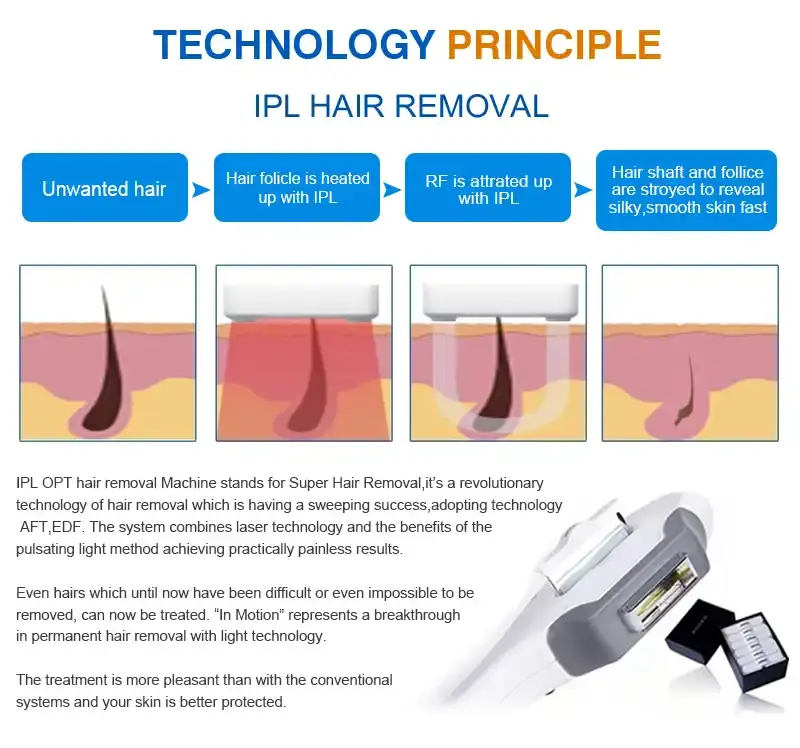
Super Hair Removal technology works through cumulative thermal damage rather than instantaneous destruction. The handpiece moves across treatment areas and delivers ten light pulses per second at a frequency of 10Hz. Each pulse contributes moderate heat to the hair follicle and the stem cell niche, gradually elevating tissue temperature until it reaches the target range of 45°C to 50°C. At these temperatures, follicular cells undergo apoptosis without triggering pain receptors in the surrounding dermis. This gradual heating approach offers several clinical advantages. Clients with darker skin tones (Fitzpatrick types IV-V) can receive safe treatment because energy accumulates slowly, avoiding sudden temperature spikes that might trigger post-inflammatory hyperpigmentation. Tanned skin can now be treated, which was normally a contraindication for older laser systems. The method also addresses finer, lighter hairs more effectively OPT SHR laser hair removal than single-pulse systems because repeated exposures compensate for lower melanin content.
Multi-Wavelength Versatility for Diverse Applications
Modern treatment platforms offer more than just hair removal; they provide comprehensive aesthetic solutions. Our equipment features four Nd: YAG laser wavelengths (532nm, 755nm, 1064nm, and 1320nm) and seven IPL wavelengths (430nm through 750nm), enabling practitioners to address varied clinical needs with one device. The 640nm filter optimises hair removal across most skin types, while 532nm targets vascular lesions and red pigments. The 1064nm Nd: YAG wavelength penetrates deeply to address stubborn dark hair and performs tattoo removal in blue and black inks. This multi-functionality transforms a hair removal device into a revenue-diversifying asset. Clinics can offer skin rejuvenation using photo-stimulation wavelengths, treat acne with blue light, remove pigmented lesions with carbon peels, and more—all from a single platform. The 10.4-inch colour touchscreen interface allows quick protocol switching between treatment modalities, minimising idle time between clients.
OPT SHR vs Traditional and Other Laser Hair Removal Technologies
Pain Perception and Client Comfort
Traditional diode lasers deliver concentrated energy in single pulses, creating the characteristic "rubber band snap" sensation that makes some clients avoid follow-up sessions. Alexandrite lasers, while effective on lighter skin, produce similar discomfort due to high peak power. Traditional IPL systems with irregular pulse trains can also cause unpredictable hot spots. The in-motion technique fundamentally changes the treatment experience. Continuous gliding movement combined with high-frequency, low-energy pulses creates a warming sensation rather than sharp pain. Many clients describe the sessions as comparable to a hot stone massage. This comfort advantage reduces treatment anxiety, improves compliance across multi-session protocols, and generates positive word-of-mouth marketing. Practices report significantly lower cancellation rates compared to facilities using stamping-method lasers.
Treatment Speed and Throughput
Speed directly affects practice economics. Standard laser protocols require careful placement of the handpiece, pulse delivery, and a cooling interval before repositioning—a stamping method that makes large-area treatments time-consuming. A full back treatment might require 45 to 60 minutes with traditional diode lasers. Our system's 15×50mm spot size, combined with a 10Hz repetition rate and in-motion application, reduces that same treatment to approximately 15 minutes. The large treatment window covers more surface area per pulse, while continuous motion eliminates repositioning delays. This threefold speed improvement enables clinics to schedule more appointments daily, directly increasing revenue per equipment unit. For high-volume practices, the return on investment timeline shortens considerably when patient throughput triples.
Skin Type Versatility
Older laser technologies faced strict limitations regarding skin phototype. Alexandrite lasers work well on Fitzpatrick types I-III but pose burn risks for darker skin. Traditional IPL systems carried similar restrictions due to high peak energy that could damage melanin in the epidermis rather than hair follicles.SHR technology's gradual heating mechanism extends safe treatment to Fitzpatrick types IV and V. The distributed energy delivery allows sufficient follicular heating without creating dangerous epidermal temperatures. This capability opens your practice to diverse demographics and expands your addressable market. Geographic regions with mixed-ethnicity populations represent substantial untapped revenue that OPT SHR laser hair removal and older technologies couldn't safely address. Practices can confidently market to clients previously told they weren't candidates for laser hair removal.
How Many Sessions Are Needed and What to Expect During OPT SHR Treatments
Treatment Protocol and Session Frequency
Hair follicles cycle through three phases: anagen (active growth), catagen (transition), and telogen (resting). Light-based hair removal only affects follicles in active growth because these contain sufficient melanin for energy absorption. At any given time, only 20-30% of body hair is in the anagen phase, with percentages varying by body location. Effective permanent hair reduction requires treating follicles as they enter the growth phase across multiple cycles. Standard protocols involve 4-6 sessions spaced 4-6 weeks apart for most body areas, with facial treatments scheduled every 3-4 weeks due to faster hair cycling. This schedule captures progressive waves of follicles entering the anagen phase, ultimately treating the entire follicular population in a given area. Individual variation affects session requirements. Clients with hormonal imbalances, polycystic ovarian syndrome, or those taking certain medications may need additional sessions. Thick, coarse hair responds more readily than fine, light hair. The gradual heating method of SHR technology performs better on challenging hair types, often reducing total session requirements by 2-3 treatments relative to older IPL protocols.
Pre-Treatment Preparation
Proper client preparation optimises treatment outcomes and minimises adverse effects. Clients must shave treatment areas 24 hours before their appointment—the hair shaft must be removed, but the melanin-containing follicle must remain intact below the skin surface. Waxing, plucking, or threading are prohibited for six weeks prior to because these remove the target chromophore. Sun exposure poses risks by increasing epidermal melanin, which competes with follicular melanin for light absorption. Clients should avoid tanning for four weeks before treatment and use broad-spectrum SPF 30+ sunscreen on treated areas. Those with recent sun exposure may need rescheduling to prevent complications. Certain medications increase photosensitivity, including tetracyclines, retinoids, and some diuretics—medical history screening identifies these risks during consultation. During the initial consultation, practitioners should photograph treatment areas, assess skin type using the Fitzpatrick scale, and discuss realistic outcomes. Managing expectations regarding complete hair removal versus permanent hair reduction prevents dissatisfaction. Most clients achieve 75-90% reduction, with remaining hair typically finer and lighter.
The Treatment Experience
Before a session, the treatment area is cleansed to remove lotions, oils, or cosmetics that might interfere with light transmission. Practitioners and clients wear protective eyewear, as safety protocols require eye protection during any light-based treatment. A thin layer of coupling gel is applied to the skin before treatment begins. This gel facilitates smooth handpiece gliding, provides thermal coupling between the sapphire crystal and skin, and protects the skin surface. The practitioner then adjusts energy settings based on skin type, hair characteristics, and treatment area. The in-motion treatment involves continuous gliding of the handpiece across the area in overlapping passes. Clients feel warmth building gradually rather than sharp pulses. Most describe the sensation as pleasant or entirely comfortable. Sapphire cooling maintains skin surface comfort even as dermal temperatures rise to therapeutic levels. A full lower leg treatment typically takes 10-15 minutes, while upper lip treatments require only 2-3 minutes.
Procurement and Market Insights: Buying OPT SHR Technology for Your Business
Critical Technical Specifications
Several specifications directly affect clinical performance and versatility. Energy output determines treatment effectiveness—our system delivers 1-50 J/cm² for IPL applications and 1-2000mJ for Nd: YAG functions, providing sufficient power across all clinical scenarios. Underpowered systems force practitioners to use maximum settings continually, accelerating component wear. Adjustable frequency (1-10Hz) allows practitioners to customise treatment pace. Higher frequencies suit experienced operators and large areas, while lower frequencies benefit training scenarios or sensitive clients. Spot size significantly impacts treatment speed—our 15×50mm window covers 7.5 cm² per pulse, which is 3-5× faster than many competing systems covering only 1-3 cm². Cooling technology deserves careful evaluation. Systems relying solely on air cooling or contact cooling without active refrigeration struggle to maintain consistent temperatures during rapid-fire pulses. Our sapphire TEC cooling combined with internal water circulation maintains crystal temperatures below -20°C throughout extended treatment sessions, preventing heat accumulation that degrades comfort and safety.
Supplier Evaluation and Certification
The supplier's track record and certifications, OPT SHR laser hair removal, provide confidence in equipment reliability and post-purchase support. TB brings over 15 years of manufacturing experience, specifically in laser and light-based aesthetic devices. Our factory establishment in 2009 has allowed us to develop deep expertise through thousands of installations across 180+ countries.CE certification confirms compliance with European Union safety, health, and environmental standards—essential for international marketability. ISO13485 certification verifies that our quality management systems meet medical device manufacturing standards. These certifications reflect systematic processes that ensure consistent product quality, rigorous testing, and traceability. Supplier stability matters for long-term support. Companies that manufacture diverse product lines demonstrate resilience against market shifts. TB's portfolio extends beyond hair removal to include fractional RF systems, HIFU devices, body contouring platforms, and skin treatment solutions. This diversification indicates financial stability and sustained R&D investment.
Total Cost Analysis and ROI
Purchase price represents only one component of total ownership cost. Consumables, maintenance, and operational efficiency affect profitability throughout the device's life. Our UK-manufactured xenon lamps provide 500,000-shot lifespans, with replacement costs that allow for accurate long-term budgeting. High-quality lamps maintain consistent output throughout their life, ensuring uniform treatment results for years. Energy efficiency impacts operating costs subtly but consistently. A 2000W power supply delivers ample output for maximum clinical settings while maintaining reasonable electrical consumption. Practices operating devices 40+ hours weekly will notice differences in annual utility costs. Revenue generation potential depends on treatment speed and service pricing. Assuming conservative pricing of $150 for lower leg treatments and a 15-minute session duration, one operator can generate $600 hourly revenue. With 20 treatment hours weekly, annual revenue potential exceeds $600,000 from hair removal alone, not including complementary services. Most practices recover equipment investment within 6-12 months.
Conclusion
Advances in OPT SHR laser hair removal technology represent a significant evolution in permanent hair reduction, addressing longstanding barriers of pain, treatment time, and skin type limitations. The combination of optimised pulse delivery, high-frequency operation, and comprehensive cooling creates comfortable, efficient treatments that satisfy clients while maximising practice productivity. For B2B buyers evaluating hair removal investments, these systems offer compelling advantages: faster treatments increase daily revenue capacity, broader skin type compatibility expands addressable markets, and multi-function platforms enable service diversification. As the aesthetic medicine market continues to grow—projected to exceed $15 billion globally by 2025—practices equipped with versatile, client-friendly technology will capture disproportionate market share by delivering superior experiences.
FAQ
1. Does OPT SHR provide permanent hair removal results?
The technology achieves permanent hair reduction rather than complete removal. After completing their treatment series, most clients experience a 75-90% decrease in hair, with the remaining hair being finer and lighter. Results depend on hormonal factors, hair characteristics, and adherence to protocol. Unlike temporary methods, treated follicles remain inactive long-term, though maintenance sessions once or twice yearly may be needed to address newly activated follicles.
2. What side effects should clients expect?
Side effects are typically mild and temporary. Clients commonly experience slight redness and warmth immediately after treatment, which usually resolves within hours. Proper sun protection prevents post-inflammatory pigmentation changes. Temporary hyperpigmentation or hypopigmentation may occur if post-treatment care instructions aren't followed. The gradual heating mechanism of OPT SHR laser hair removal significantly reduces the risk of burns or blistering compared to high-peak-energy systems.
3. Why is the treatment considered painless compared to traditional lasers?
The pain reduction stems from how energy gets delivered. Traditional single-pulse lasers create sudden temperature spikes that activate pain receptors sharply—the "rubber band snap" sensation. SHR distributes equivalent total energy across many low-intensity pulses delivered rapidly, creating gradual warming rather than sharp thermal shocks. Simultaneous sapphire cooling keeps skin surface temperatures low throughout treatment. Most clients describe the sensation as a warm massage rather than painful snapping.
Partner with Taibo Beauty for Advanced OPT SHR Laser Equipment
Clinic operators and procurement professionals seeking a reliable OPT SHR laser hair removal manufacturer will find comprehensive solutions at Taibo Beauty. Established in 2009, our factory combines 15 years of specialised manufacturing expertise with CE and ISO13485 certifications that validate our commitment to quality and safety. The multi-wavelength platform we've developed—featuring seven IPL wavelengths and four Nd: YAG options—delivers exceptional versatility that extends your service offerings beyond hair removal into skin rejuvenation, tattoo removal, and vascular treatments. Our dual cooling system with sapphire TEC technology maintains client comfort throughout sessions, while the large 15×50mm spot size accelerates treatments to maximise your daily appointment capacity. We support partners with comprehensive training, responsive technical assistance, and OEM customisation options for distributors building proprietary equipment lines. Contact susan@taibobeauty.com to discuss how our technology can enhance your clinic's capabilities and profitability.
References
1. Anderson, R.R., & Parrish, J.A. (1983). Selective photothermolysis: precise microsurgery by selective absorption of pulsed radiation. Science, 220(4596), 524-527.
2. Haedersdal, M., Beerwerth, F., & Nash, J.F. (2011). Laser and intense pulsed light hair removal technologies: from professional to home use. British Journal of Dermatology, 165(s3), 31-36.
3. Gold, M.H., & Sensing, W. (2011). Optimal pulse technology: a review. Journal of Cosmetic Dermatology, 10(2), 150-155.
4. Lanigan, S.W. (2003). Management of unwanted hair in females. Clinical and Experimental Dermatology, 28(4), 369-373.
5. Raulin, C., Greve, B., & Grema, H. (2003). IPL technology: a review. Lasers in Surgery and Medicine, 32(2), 78-87.
6. Town, G., & Ash, C. (2010). Are all IPL treatments the same? Journal of Cosmetic and Laser Therapy, 12(3), 149-154.





YOU MAY LIKE