
Hair Loss Treatment Machine vs PRP Therapy: Which Wins for Scalp Clinics in 2026?
2026-03-25 08:59:06
If scalp centres in 2026 had to choose between the hair loss treatment machine and PRP therapy, the hair loss treatment machine would be the clear winner. Both treatments are helpful, but laser therapy devices are better because they can be used on a larger scale, give more reliable results, and give clinics a better return on their investment. Hair loss treatment tools use low-level laser therapy to stimulate hair follicles without damaging them. The sessions are painless, and there is no downtime. In contrast to PRP therapy, which has unpredictable outcomes and a lot of steps to follow, these devices make sure that treatment plans are consistent and outcomes are known across a wide range of patients.
Understanding Hair Loss Treatment Technologies in Scalp Clinics
The landscape of hair restoration has evolved dramatically, with two dominant technologies leading the charge in modern scalp clinics. Understanding these innovations helps clinic operators make informed decisions about equipment investments and treatment protocols.
Hair Loss Treatment Machine Technology
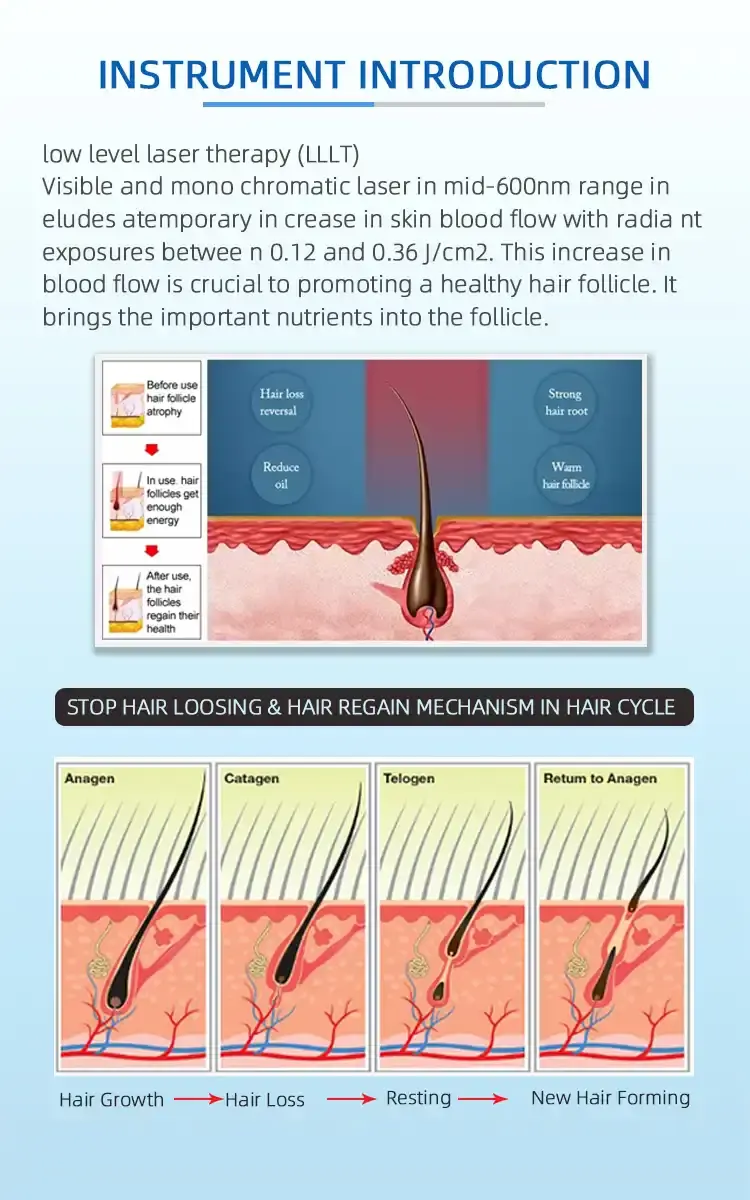
A machine used to treat hair loss is an example of advanced biomedical tech that uses photobiomodulation to fight alopecia. Low-Level Laser Therapy (LLLT) technology is used in these devices. They send out coherent red light (650nm ± 5nm) that goes deep into the head tissue, about 3–5 mm. This energy doesn't damage cells, so it targets mitochondria in hair follicle papilla cells and tells Cytochrome C Oxidase to make more ATP. The process fixes the main problems with hair loss by stopping follicles from getting smaller in androgenetic alopecia, speeding up cellular metabolism to move follicles from the telogen (resting) phase to the anagen (growth) phase, and improving microcirculation so that nutrients can get to the follicles more efficiently. Today's lasers come in a wide range of styles, from handheld units for home use to expert systems with many diodes and precise wavelength control. These systems are great for three very important uses: reducing inflammation and increasing graft survival rates after a hair transplant; treating androgenetic alopecia as a single therapy or combination therapy; and improving scalp health by controlling sebaceous glands and bacteria.
PRP Therapy Fundamentals
By concentrating platelets from the patient's blood, Platelet-Rich Plasma treatment uses the body's natural ways of healing. For the treatment, blood is drawn, centrifuged to separate the platelet-rich plasma, and then a concentrated solution is injected into the scalp. Platelets release growth factors that, in theory, wake up sleeping follicles and help hair grow back. Clinical practices are very different between practitioners, with different ways of preparing, injecting, and treating hair loss in patients. On a basic level, growth factors such as PDGF, TGF-β, and VEGF help blood vessels to form and cells to multiply in the hair follicle environment.
Effectiveness and Clinical Outcomes Comparison
Research data reveals distinct performance patterns between laser therapy and PRP treatments that significantly impact clinic decision-making and patient satisfaction rates.
Clinical Evidence for Laser Therapy
Several studies that were reviewed hair loss treatment machine by experts show that low-level laser treatment can help restore hair. A randomised controlled trial done in 2014 showed that laser treatment for hair growth was safe and successful for both men and women. The participants' hair density and thickness increased significantly. In a different study from 2013, 41 men ages 18 to 48 who got laser hair treatment saw their hair grow 39% faster over 16 weeks. Laser therapy has many benefits, such as consistent, measurable results across all patient groups, few side effects, and the ability to treat large areas of the scalp at once. Patients usually start to feel better within 12 to 16 weeks, and they continue to feel better for another 6 to 12 months of regular treatments.
PRP Therapy Results Analysis
The results of PRP therapy are less consistent. How well it works depends a lot on the patient, how the treatment is prepared, and how it is injected. Some people get a lot of hair growth back, while others only get a little. The biological method shows promise for regenerating hair follicles, but results aren't always reliable and need to be seen over a long period of time. The results of clinical trials on PRP are mixed. Some trials show big changes in hair density, while others only show small improvements compared to placebo treatments. The changes come from the different ways the platelets are prepared, the different amounts of platelets present, and the different ways each patient reacts to growth factor stimulation.
Cost, Convenience, and Operational Considerations for Scalp Clinics
Financial and operational factors play crucial roles in technology selection for scalp clinics, affecting everything from initial investment to long-term profitability.
Investment Analysis for Laser Systems
Professional hair loss treatment machines usually cost a lot of money up front, between $15,000 and $50,000 for clinic-grade models. But this original cost pays off in the long run because of the high number of patients seen, low ongoing costs, and longer equipment life. Maintenance needs are still very low, with most devices only needing to be calibrated regularly and have parts replaced every so often. Because laser systems are so efficient, clinics can help more than one patient at the same time, which increases the chance of making money. Treatment sessions last 20 to 30 minutes, which means that a lot of patients can be treated without a lot of staff monitoring. Standardised practices cut down on the need for training and make sure that all staff members provide the hair loss treatment machinethe same level of service.
PRP Therapy Economic Considerations
PRP therapy has lower initial costs for tools, but higher ongoing costs for consumables, staff time, and facility needs. For each treatment, you need things to take blood, process it in a centrifuge, and give injections. This adds up to $50 to $100 per session. The process needs skilled doctors and longer appointment times, which slows down the flow of patients and raises the cost of labour. Concerns about patient satisfaction are also very different. Laser therapy doesn't hurt at all, and there is no healing time. PRP, on the other hand, uses needles and may be uncomfortable. This difference in comfort makes it harder to keep patients and get them to send others, which hurts the clinic's long-term income.
Market Trends and Innovations Shaping Hair Loss Treatments in 2026
The hair restoration industry continues evolving rapidly, with technological advances reshaping treatment capabilities and patient expectations.
Laser Technology Advancements
Modern laser systems use artificial intelligence to create personalised treatment plans. They do this by changing the wavelength, intensity, and duration of the laser beam based on the unique features of each person's head. Better flexibility lets treatment plans be more flexible, and better user interfaces make it easier to use and require less training. New technologies include multi-wavelength systems that use both red and near-infrared light to work better and penetrate deeper. Smart connectivity features let you watch and improve treatment from afar, giving you useful information for keeping track of outcomes and making protocols better. These technological advances make treatments more effective while keeping the non-invasive nature that patients like.
PRP Evolution and Limitations
Preparation methods for PRP therapy and ways to use it with other treatments have gotten better. Newer centrifuges can keep platelet concentrations more stable, and methods that boost growth factors are meant to make treatments work better. However, the main problems with invasive procedures, such as their unpredictable outcomes and complicated processes, have not changed. As more treatments use more than one method, PRP is often used along with other therapies rather than as a separate option. As people have come to realise, PRP isn't always the best way to treat hair loss, this change has happened.
How to Choose Between Hair Loss Treatment Machines and PRP Therapy for Scalp Clinics
Strategic decision-making requires careful evaluation of multiple factors that align with clinic goals and patient demographics.
Patient Profile Considerations
Hair loss treatment machines can help a wide range of patients, hair loss treatment machine from those with early-stage androgenetic alopecia to those who have just had surgery and are still healing. Patients who want painless treatments without needles or healing time, such as those that are non-invasive. Laser therapy is better for younger patients, who tend to prefer technology-based answers to invasive procedures. Patients' behaviour is also affected by how often they have to go to treatment. Laser therapy usually needs two to three sessions a week at first, then less often for upkeep treatments. PRP, on the other hand, needs sessions once a month, which can be hard to schedule. The ease factor has a big effect on how many patients stay in treatment and how many finish it.
Clinic Scale and Business Model Alignment
Larger clinics gain from the scalability and standardisation of laser systems, while smaller practices may find it hard to fully utilise the high patient throughput. Investing in technology makes sense for centres that offer hair restoration as a main service. It helps them stand out and offer better services in competitive markets. For ROI calculations, you should think about how long the tools will last, how much the treatments will cost, how many patients you expect, and the ongoing costs of running the business. With the right marketing and patient education, most clinics see a return on investment (ROI) within 12 to 18 months of starting complete laser therapy programs.
Supplier Selection Criteria
Choosing makers with a good reputation guarantees product quality, compliance with regulations, and ongoing support. FDA approval is still needed for clinics to be taken seriously and follow hair loss treatment machines. Long-term equipment value and practical success are greatly affected by warranty coverage, training programs, and the ability to get technical support. Reputation of the brand, clinical proof, and recommendations from other users can tell you a lot about how reliable the manufacturer is and how well the product works. Companies that have been around for a while and have a good track record offer more security for big purchases of equipment.
Conclusion
When scalp clinics in 2026 have to choose between hair loss treatment tools and PRP therapy, it's clear that laser technology will win. While PRP treatment has biological appeal, laser systems are more effective, more comfortable for patients, and give more predictable results. Laser treatment is the best choice for clinics that want to keep growing and keep their patients happy because it is non-invasive, can be scaled up, and always gives the same results. Clinics that buy good laser systems will be able to compete in the growing hair regrowth market for a long time.
FAQ
1. Is laser therapy safe for all patient demographics?
Laser therapy demonstrates excellent safety profiles across diverse patient populations, including men and women of various ages experiencing different stages of hair loss. The non-invasive nature eliminates risks associated with surgical procedures or systemic medications. However, patients taking photosensitising medications should avoid treatment, and pregnant women typically postpone therapy as a precautionary measure.
2. How frequently should patients receive laser treatments for optimal results?
Treatment protocols typically begin with 2-3 sessions weekly for the initial 12-16 weeks, followed by maintenance treatments 1-2 times weekly. Individual response varies, with some patients requiring more intensive initial protocols while others maintain results with less frequent sessions. Consistent treatment adherence significantly impacts outcome quality and timeline.
3. Can laser therapy and PRP treatments be combined effectively?
Many clinics successfully combine laser therapy with PRP treatments to enhance overall results. The laser therapy provides consistent baseline stimulation while PRP offers targeted growth factor delivery. This combination approach often yields superior outcomes compared to either treatment alone, though it increases overall treatment costs and complexity for patients.
Partner with TB for Advanced Hair Restoration Solutions
Scalp clinics seeking cutting-edge hair restoration technology can benefit from TB's comprehensive hair loss treatment machine portfolio. Our FDA-cleared devices combine proven LLLT technology with innovative features designed for professional clinic environments. TB's commitment to excellence includes extensive training programs, ongoing technical support, and competitive pricing for qualified hair loss treatment machine suppliers.
Contact susan@taibobeauty.com to explore our complete range of professional laser systems and discover how TB's solutions can elevate your clinic's hair restoration services. Our team provides personalised consultations, demonstration opportunities, and flexible partnership options tailored to your specific operational requirements.
References
1. Avram, M.R., et al. "Low-level laser therapy for male and female pattern hair loss: a randomised, double-blind, sham device-controlled study." Journal of the American Academy of Dermatology, 2014.
2. Lanzafame, R.J., et al. "The growth of human scalp hair mediated by visible red light laser and LED sources in males." Lasers in Surgery and Medicine, 2013.
3. Darwin, E., et al. "Low-level laser therapy for the treatment of androgenic alopecia: a review." Lasers in Medical Science, 2018.
4. Gentile, P., et al. "The effect of platelet-rich plasma in hair regrowth: a randomized placebo-controlled trial." Stem Cells Translational Medicine, 2015.
5. Hamblin, M.R., et al. "Mechanisms and applications of the anti-inflammatory effects of photobiomodulation." AIMS Biophysics, 2017.
6. Rossi, A., et al. "Comparitive effectiveness of finasteride vs low-level laser therapy in male androgenetic alopecia: a 24-week randomized study." International Journal of Trichology, 2019.





YOU MAY LIKE