Any technology works best when users are trained to use it, identify their skin type, plan treatments, and handle emergencies. Before thorough therapy, clinicians need Fitzpatrick classification systems, detailed conversations, medical history, prescription lists, and test patches. Proper training on the diode 808 laser hair removal machine also enhances treatment effectiveness. Diode lasers need weekly cooling system checks, monthly water quality testing, and annual expert service. Replace IPL flashlamps and record pulses before failure. Professional records of therapy parameters, energy, and patient responses improve quality and risk management.

English

Diode 808 Laser Hair Removal Machine vs IPL: Full Comparison
2026-04-15 08:58:13
To choose hair removal technology for your beauty business, compare diode 808 laser systems, especially the diode 808 laser Hair Removal Machine, to IPL. The Diode 808 laser permanently removes hair by targeting melanin in hair cells at 808nm and firing coherent light deep into the skin. Broad-spectrum, multi-colored IPL devices treat numerous illnesses, but they are less precise and shallower. B2B clinic, spa, and dermatological center buyers' treatment outcomes, customer happiness, operational efficiency, and ROI are affected by this difference. Technology may boost company performance, cut expenses, and boost safety.
Introduction
1. Over 20 years, hair removal technology has advanced. Medical spas, dermatology clinics, and beauty centers worldwide offer it. When buying new equipment, purchasing managers, engineers, and dealers must understand diode laser and IPL applications. Most professional hair removal uses IPL and 808nm diode lasers. Client type, treatment number, and corporate model affect benefits.
2. Professional laser equipment from Xi'an Taibo Laser Beauty has been exported to 180+ countries for 15 years. Showing B2B equipment buyers' wants. Technological, clinical, economic, and strategy variables influence buying decisions in this extensive comparison. This study gives you the proof to make smart technology investments to enhance income and client retention if you're expanding services, creating a new location, or selling equipment.
Understanding Diode 808 Laser and IPL Technologies
How Diode 808 Laser Technology Works
The diode 808 laser hair removal machine works by selective photothermolysis, which means that certain bands of continuous light target chromophores in tissue structures. Because 808nm is in the best range for melanin absorption, laser energy can go 3–4 mm into the dermis, where hair root bulbs are located. When this focused light energy hits melanin, it changes into heat energy. This heats the follicle structure to 65–70°C, which is the right temperature to denature proteins in the hair matrix and the stem cells that make hair grow back. Modern triple-wavelength systems have a handpiece that combines 755nm, 808nm, and 1064nm wavelengths. This lets professionals tailor treatments to different skin types and hair colors. At Taibo, our high-tech systems have American Coherent laser bars with FAC technology. These bars ensure at least 50 million shots per handpiece, which is an important factor for high-volume offices that need to figure out cost-per-treatment. With spot sizes of 12x36mm, the laser quickly treats big areas with either continuous waves or pulses of energy at speeds between 1 and 10Hz. The technology uses sapphire crystal screens to cool the skin directly, keeping temperatures as low as -4°C to -17°C. This protects the epidermis while letting intense energy reach lower tissue layers. This ability to cool is a big improvement because it makes treatments almost painless, which older laser generations couldn't do without external anesthetics.
IPL Technology Fundamentals
Intense Pulsed Light devices emit erratic, multicolored light. The light is 500-1200nm. IPL blocks shorter wavelengths and lets some enter the skin, unlike lasers. IPL is flexible because to its wide wavelength range. Changes in filter settings and pulse factors on the same device can eliminate hair, heal vascular lesions, brighten skin, and stimulate collagen synthesis. IPL damages target structures by heating melanin and hemoglobin chromophores like lasers. Large body portions are swiftly illuminated by broad treatment windows (10-50 mm²). Depending on brand and power, capacitor-based flashlamps in IPL systems need replacement every 100,000–300,000 pulses. Aiming is incorrect and penetration narrow because non-coherent light penetrates tissue more than laser energy. This makes it safer for beginners but less effective for deep pores or darker skin. The majority of IPL equipment is cheaper than medical diode lasers. Small companies and beauty salons can readily add services.
Key Technical Distinctions for Procurement Decisions
Knowing these practical differences aids business tool selection. Diode lasers are more accurate, deeper, and constant in patients. Creating safe and effective dark skin IPL devices is difficult (Fitzpatrick IV–VI). Wavelength accuracy reduces dispersed energy, hyperpigmentation, and burns. Laser and IPL systems replace water filters, coolant systems, and flashlamps, raising long-term expenses. Also crucial is treatment speed. In contrast to 30–45 minutes for typical IPL, high-frequency diode systems with in-motion treatment modes eliminate full-leg hair in 15–20 minutes. The schedule, daily income, and client satisfaction are affected. Multi-location and franchise purchasers value equipment standardization. Diode laser systems simplify training and quality control due to operator and site homogeneity.
Effectiveness and Safety Comparison
Clinical Efficacy Across Skin Types and Hair Colors
Peer-reviewed clinical studies show that tailored 808nm diode laser systems can permanently remove 75% to 95% of hair in 6 to 8 sessions. Even tanned or naturally darker Fitzpatrick skin types (I–VI) can use 808nm light with proper cooling and energy settings. Triple-wavelength platforms change. Due to their ability to diminish epidermal melanin absorption, 755nm Alexandrite wavelengths perform best on light skin and fine hair (types I–III), 808nm on medium skin and a variety of hair types, and 1064nm Nd:YAG on dark skin Lighter skin (I–IV) and darker hair improve from IPL. Best-case situations demonstrate 60–80% sustained decline after 8–12 sessions. More wavelengths are absorbed by the epidermis, limiting energy transfer to darker hair follicles and increasing risk. Without melanin, IPL doesn't function on blonde, red, and gray hair. All patients can't be treated. Journal of Cosmetic and Laser Therapy: Diode lasers achieve results in less sessions. This affects therapy client satisfaction and earnings.
Safety Profiles and Regulatory Compliance
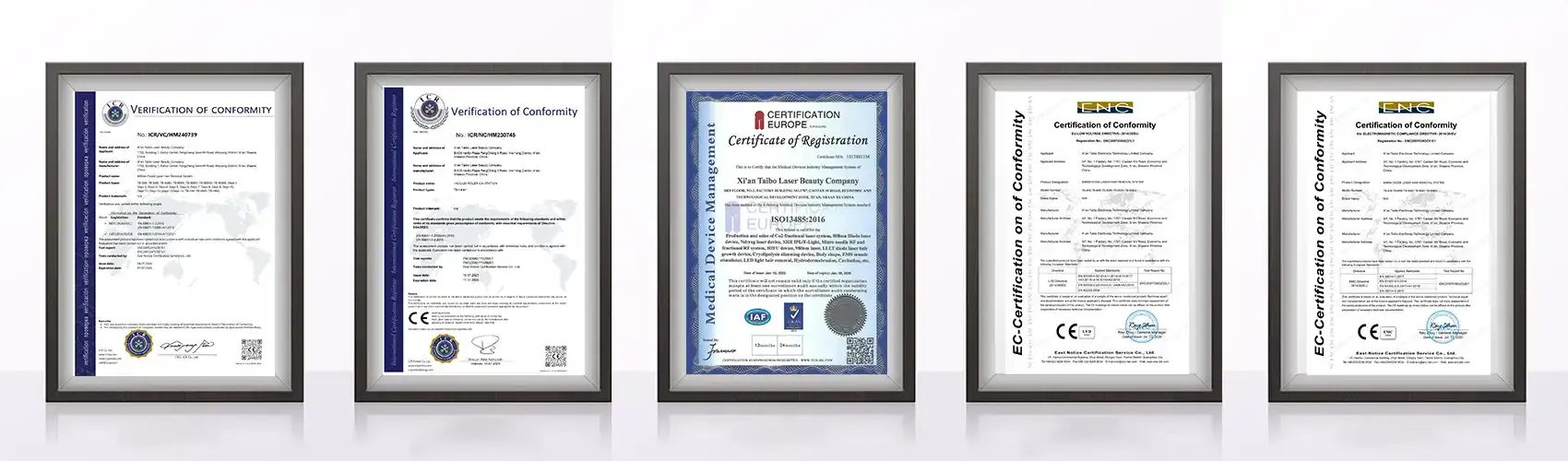
Both technologies can be used safely by trained personnel following manufacturer specifications. Diode laser systems protect skin with real-time temperature tracking, pulse duration range (10–400ms), and contact cooling. Taibo handpiece LCDs show sapphire temperature continuously. The operator can verify cooling before each pulse. CE and ISO 13485 certifications ensure these devices meet European and global medical device and quality control requirements. US models often promise FDA-approved permanent hair removal. Personalized therapy has typical side effects. Transient redness lasts 2–24 hours in 30–50% of treatments, and perifollicular edema sometimes disappears within hours. Poor patient care, operator error, and insufficient cooling cause hyperpigmentation, hypopigmentation, and surface burns. Dark or too much brown skin makes IPL risky, whereas pale skin is safe. The technology's larger wavelength range makes tissue interactions unpredictable, requiring cautious energy sets that may lower safety limits.
Operational Best Practices for Professional Settings
Cost, Procurement, and ROI Analysis
Initial Investment and Equipment Costs
Technology, power, and business position set professional hair removal equipment pricing. Medical-grade diode 808 laser systems cost $25,000 to $85,000, depending on laser power (600W to 3000W), wavelength (808nm vs. triple-wavelength), and cooling system performance. Advanced medical-grade IPL systems with many applicators and settings cost $40,000. Cheap beauty parlor IPL equipment cost $8,000. IPL beginning costs are lower, but buyers should weigh all variables. Powerful diode systems should cost more to cure more patients faster. Triple-wavelength 2000W devices finish treatments 40–60% faster than 800W single-wavelength equipment. Treats more patients daily without remaining open longer. A clinic with 12 $150 treatments a day makes $270,000 a year with one gadget's throughput. Standards cost $20,000–$30,000, but scheduling space pays for them in a few months. When buying multiple units or starting a practice, consider equipment loans, leases, and seller credit.
Operational Costs and Maintenance Expenses
Besides purchase expenses, operating expenses affect long-term profits. Diode lasers cost little. The 50 million-shot Coherent laser bars can be replaced after 10,000–15,000 treatments. Regular cooling system water and filter changes cost $200–$500 annually. 2000W devices for full-body treatments use 3–4 kWh and are cheap in most countries. Replace IPL flashlamps every 100,000–300,000 pulses for $800–$2,500. It raises machine lifetime cost-per-treatment. Patient and therapy determine realistic costs. For permanent hair reduction, diode laser hair removal requires 6–8 treatments and IPL 8–12. Session difference goes beyond device cost. It affects timetables, front desk staff, treatment room use, and client retention. Each technique involves labor, but diode systems' faster treatment times save session labor. Complete financial models need insurance and staff licenses. Different licenses are needed for laser and IPL.
ROI Calculations and Profitability Metrics
Return on investment should surpass tool payback. Other revenue factors should be considered. A $180 diode 808 laser system that performs 15 treatments a week generates $140,400 a year, covering the initial expenditure in 4–5 months at 80% capacity. Treatment mix, pricing, annual demand changes, marketing costs to sustain booking rates, and local market competitiveness are ROI factors. Premium laser practices charge 15–25% more than IPL providers with the same technology, but their conversion rates are higher due to better laser performance and fewer sessions. Long-term profits depend on supplier warranties and support. Our 24/7 professional support team can help with investment difficulties, and our two-year guarantee covers part failure. When equipment breaks, procedures should anticipate revenue loss. Clinics spend $5,000–$8,000 on two-week item breakages. Consider supplier after-sales support, spare parts, training, and manufacturer name together with price. OEM customisation firms like Xi'an Taibo Laser Beauty offer security and help that newer ones cannot with 15 years of export expertise.
Market Comparison and Decision-Making Guidelines
Diode 808 vs Alternative Laser Technologies
Professional hair removal devices go beyond diode lasers. Alexandrite lasers (755nm)'s quick repetition rates and large spot diameters benefit high-volume facilities treating lighter skin. Safety concerns prevent darker-skinned patients from using 808nm. Nd:YAG lasers (1064nm) work best on dark skin and less on thin hair because they absorb less melanin. Doctors think 755nm, 808nm, and 1064nm triple-wavelength diode platforms are the most versatile since they can cure many patients without lasers. Recent SHRs differ from diodes in surprising ways. Super Hair Removal gently heats skin with quick, low-energy pulses. The process should hurt less. The results resemble diode methods. Techniques vary more in operator skill and patient comfort than technology. The same rules apply to all photothermolysis. Treatment feels different, technique is changeable, and results vary. Diode 808 business-to-business purchase systems are effective, scientifically backed, and practitioner-known, simplifying staff training and patient acceptance.
Aligning Technology Choice with Business Models
Strategically select company and audience tools. Triple-wavelength diode systems offer extra treatment options for busy medical spas and skin centers. Treating all skin types safely and efficiently lowers patient selection problems, which limit income growth. Lighter-skinned beauty salons and spas may benefit from IPL photorejuvenation and vascular treatments. Multiple uses for equipment. Mobile beauty companies prefer lightweight, easy-to-use equipment over power. Geographic market conditions affect technology choice. Northern Europe and certain lighter-skinned US states use IPL. Diode systems are more desirable and adaptable. Competition analysis matters. Improved diode laser technology can justify higher prices in IPL-dominated industries. IPL could succeed in competitive laser markets by offering underserved clientele alternative features, comfort, speed, or treatment modalities.
Decision Framework for Equipment Evaluation
Evaluation criteria streamline procurement and achieve long-term goals. Hair color, skin type, and treatment location should affect performance, especially when using a diode 808 laser hair removal machine. Cost-efficiency studies must go beyond price. With reasonable capacity forecasts, it must include longevity, operational costs, and profit possibilities. Medical offices need safety rules. Beauty companies may take less for local laws and insurance. Equipment standards should be assessed like vendors. Manufacturers should offer clear communication, technical documentation, thorough training, and timely after-sales assistance. Consult client references for performance, dependability, and problem-solving quickness. Foreign purchases can avoid costly delays and complications if the vendor manages customs, shipment logistics, and installation. Purchase and communication are simplified by Taiwan's massive export network and 180-country dealer network.
Brand Insights and Supplier Recommendations
Leading Diode 808 Laser Manufacturers in 2026
Several successful diode laser companies sell beauty tools. Choose a provider based on innovation, clinical validation, guarantee coverage, and customer service. R&D, patents, and doctor-training programs are common among major firms. Since 2009, Xi'an Taibo Laser Beauty has invested in tech. It created cooling systems, ergonomic handpieces, and control interfaces to improve treatment outcomes and operator efficiency. American Coherent laser bars with FAC technology for energy efficiency and endurance, triple-wavelength platforms for diverse patients, and semiconductor refrigeration, TEC cooling, and water circulation for patient comfort are unique goods. Production, quality control, and R&D are distinct at our factory. Divisions improve products together. Quality control and assembly use Italian pumps, Japanese cooling plates, and Taiwanese power sources to make professional equipment work.
Evaluating Supplier Credibility and Support
Businesses spend on tools and need reliable suppliers. Honest manufacturers provide explicit instructions, factory tours, clinical data to support efficacy claims, and no-nonsense warranties. FDA approvals, CE marking, and ISO 13485 quality management systems prove product safety. Market and supply stability comes from decades-old enterprises. Equipment without parts or expert support is rare. Long-term pleasure comes from after-sales service, not equipment. Full training should cover device use, patient treatment, maintenance, and typical difficulties. Timely phone, email, and video chat technical support saves downtime. Easy-to-get, economical spare parts avoid long-term service outages that hurt revenue and patient satisfaction. With 24-hour service and a two-year warranty, we ensure customer satisfaction. Your success improves our image and progress.
Real-World Implementation Case Studies
Real-world examples show how strategic supplier relationships and tools help companies. Our triple-wavelength diode systems replaced IPL in eight northeastern US medical spas. In six months, hair removal income rose 40% due to more patients and fewer operations. Standards simplified cross-site worker training and increased client results and treatment homogeneity. Another busy dermatology practice had few treatments for darker skin outside Alexandrite lasers. Markets for 1064nm diodes opened. In the first year, hair removal services rose 65%. Better technical and implementation support—on-site training, protocol development, and marketing advice on where to deploy new features—led to these increases. Right equipment selection goes beyond buying devices like the diode 808 laser hair removal machine. It requires applying them to practices, training staff and patients, and competing in the market. Long-term growth and profit depend on providers who go beyond tools.
Conclusion
Compare IPL with diode 808 laser clinical performance, cost, patient type, and business model. Diode lasers serve more patients faster and better. Results and income can increase in most professional situations. The technology's accuracy, safety for all skin types, and permanent hair removal justify its high cost and location. In beauty enterprises with lighter-skinned clients, IPL benefits multifunction equipment. Finally, strategic equipment buying transcends tech. Supplier cooperation, complete support, and matching corporate goals and growth strategies with competitive aesthetic marketplaces are also addressed.
FAQ
1. Is the Diode 808 Laser Safe for All Skin Types?
When matched, medical-grade diode 808 lasers are safe for all Fitzpatrick skin types. Melanin is consistently absorbed at 808nm to target hair follicles without epidermal harm with powerful contact cooling. Professionals use 755nm bands for lighter skin, 808nm for intermediates, and 1064nm for V–VI. Improves platform safety. Most people can receive safe treatment if staff are well-trained, patients are thoroughly evaluated, energy settings are accurate, and cooling systems work.
2. What Is the Expected Lifespan of a Diode Laser System?
Professional diode lasers last 8–12 years if maintained. Quality laser bars like American Coherent have a 50 million shot warranty for 10,000–15,000 treatments. Effective cooling requires maintenance. Replace water, filters, and refrigerant. Maintainable tools, power, and control systems outlast laser bars. Maintenance, usage, and technology obsolescence determine durability.
3. How Does IPL Compare to Diode Lasers in Clinical Settings?
Several patient groups benefit from diode laser permanent hair removal. Diode systems reduce hair loss by 75% to 95%, require fewer treatments (6 to 8 vs. 8 to 12), safely treat darker skin tones, and work with all hair colors except white and gray. IPL helps multitask. The device removes hair, improves skin tone, and treats veins. This may help multi-service offices maximize tools. Although IPL provides lower start-up costs, operating and performance limits can outweigh the benefits.
Partner with Taibo for Your Diode 808 Laser Hair Removal Machine Procurement
Ready to boost your hair removal services with proven technology and thorough support? Clinics, spas, and marketing networks use Xi'an Taibo Laser Beauty's certified diode 808 laser hair removal machine supplier products. Our systems have American Coherent laser bars, three wavelengths, cutting-edge cooling, two-year contracts, and 24/7 tech support. We sell beauty equipment to over 180 countries since 2009 with high-quality items and delighted customers. Our sales team at susan@taibobeauty.com provides individualized guidance, low prices for single and large purchases, and flexible payment options. We customize Diode 808 laser hair removal equipment for wholesalers and large enterprises that want our trademarked solutions. Discuss how good tools partnerships boost business and client performance.
References
1. Anderson, R.R., & Parrish, J.A. (1983). Selective Photothermolysis: Precise Microsurgery by Selective Absorption of Pulsed Radiation. Science, 220(4596), 524-527.
2. Haedersdal, M., Beerwerth, F., & Nash, J.F. (2011). Laser and Intense Pulsed Light Hair Removal Technologies: From Professional to Home Use. British Journal of Dermatology, 165(Suppl 3), 31-36.
3. Sadick, N.S., Shaoul, J., & Boxley, J. (2004). The Efficacy and Safety of Diode Laser Hair Removal for Different Skin Phototypes. Journal of Cosmetic and Laser Therapy, 6(4), 195-200.
4. Town, G., & Ash, C. (2010). A Comparison of Fluorescence and Thermal Injuries in Laser Hair Removal. Lasers in Surgery and Medicine, 42(1), 62-68.
5. Gold, M.H. (2007). Lasers and Light Sources for Hair Removal: Current and Future Technologies. Journal of Drugs in Dermatology, 6(11), 1093-1100.
6. Lanigan, S.W. (2003). Management of Unwanted Hair in Females. Clinical and Experimental Dermatology, 28(4), 369-373.





YOU MAY LIKE