
980nm Diode Laser for Vascular Removal: The 2026 Clinic Buyer's Ultimate Guide
2026-04-03 09:00:49
As aesthetic medicine keeps getting better, the 980 nm diode laser for vascular removal stands out as a game-changer for hospitals that want to treat vascular lesions precisely and effectively. This in-depth guide looks at the most important things that clinic buyers need to think about before buying this cutting-edge equipment for 2026. This is the future of vascular treatment because it targets porphyrin-containing vascular cells with its ideal absorption spectrum and doesn't require much invasiveness. Clinic owners will be able to make choices that improve patient outcomes and maximise return on investment if they understand how the process works, compare their options, and look at key procurement factors.
Understanding 980nm Diode Laser Technology for Vascular Removal
Selective photothermolysis is at the heart of 980nm diode laser technology. This idea changes the way we treat vascular lesions in a big way. This wavelength specifically targets the absorption spectrum of porphyrin vascular cells. This makes a focused thermal effect that clots abnormal blood vessels while keeping the health of the surrounding tissue.
Mechanism of Action and Tissue Interaction
The 980nm wavelength works in a special therapeutic window that lets oxyhemoglobin uptake stay high while melanin interference is kept to a minimum. When the laser energy goes through the skin, it is absorbed by vascular cells. This causes the specific vessels to solidify right away and then break apart over time. Because of its accuracy, this laser treatment doesn't cause the general thermal damage that other laser treatments do. The focused beam design focuses energy into a range of diameters from 0.2 to 0.5 mm. This lets doctors target specific blood vessels without hurting good tissue nearby. One of the biggest problems with vascular therapy is that it can hurt skin structures nearby. This new technology fixes that problem.
Safety Profile and Treatment Considerations
Modern 980 nm diode laser systems for removing veins have improved safety features that make treatment much less dangerous. The non-contact therapy method gets rid of the problems that come with needles while keeping the treatment effective. Patients don't feel much pain during treatments, and most say they only feel a little warmth. The treatment is safe for more than just the initial procedure. Instead of having to take a lot of time off after aggressive vascular treatments, 980nm diode laser therapy lets patients go back to their regular lives right away. This technology is different from pulsed dye lasers because it doesn't cause purpura formation. This makes it perfect for face treatments where bruises would look bad.
Collagen Stimulation and Secondary Benefits
Beyond vascular removal, the 980nm wavelength stimulates dermal 980 nm diode laser for vascular removal collagen production, creating additional aesthetic benefits. This dual-action approach increases epidermal thickness and density, effectively concealing small blood vessels while enhancing overall skin quality. The improved elasticity and resistance provide long-term protection against future vascular formations.
Comparing 980nm Diode Laser with Other Vascular Removal Technologies
Selecting the optimal vascular removal technology requires understanding how different modalities perform across various clinical scenarios. The landscape includes several established technologies, each with distinct advantages and limitations that impact treatment outcomes and clinic operations.
980nm Diode vs. 1064nm Nd: YAG Laser Systems
The comparison between 980nm diode and 1064nm Nd: YAG lasers reveals significant differences in tissue interaction and clinical applications. While 1064nm systems offer deeper penetration capabilities, they often require higher fluence levels for small vessel treatment, increasing discomfort and potential side effects. The 980 nm diode laser for vascular removal provides superior absorption in superficial to mid-dermal vascular lesions, making it ideal for facial telangiectasias and spider veins. Cost considerations also favour diode laser systems. The absence of expensive consumables, such as lamp replacements or specialised cooling systems, reduces long-term operational expenses. Additionally, diode lasers demonstrate superior energy efficiency, translating to lower electricity costs and reduced environmental impact.
IPL Systems and Treatment Versatility
Intense Pulsed Light (IPL) systems offer broad-spectrum treatment capabilities but lack the precision required for individual vessel targeting. While IPL excels in treating diffuse redness and larger treatment areas, the 980nm diode laser surpasses IPL in treating resistant vessels and achieving immediate results. The precision targeting eliminates the trial-and-error approach often necessary with IPL treatments. Patient satisfaction surveys consistently favour diode laser treatments over IPL for vascular removal. The immediate vessel disappearance (blanching effect) provides instant gratification that IPL's gradual improvement cannot match. This immediate feedback enhances patient confidence and treatment compliance.
Sclerotherapy and Minimally Invasive Alternatives
Traditional sclerotherapy remains effective for larger varicose veins but presents limitations in treating small spider veins and facial vessels. The 980 nm diode laser for vascular removal addresses these limitations by treating vessels too small for sclerotherapy needles while eliminating injection-related risks such as allergic reactions or tissue necrosis. The laser approach also benefits patients with needle phobias or those seeking completely non-invasive alternatives. This expanded patient base can significantly impact clinic revenue by capturing previously untreatable demographics.
Key Considerations When Purchasing a 980nm Diode Laser Device
Successful procurement of vascular removal equipment requires careful evaluation of technical specifications, supplier credentials, and long-term operational factors. These considerations directly impact treatment efficacy, clinic profitability, and patient satisfaction outcomes.
Technical Specifications and Performance Parameters
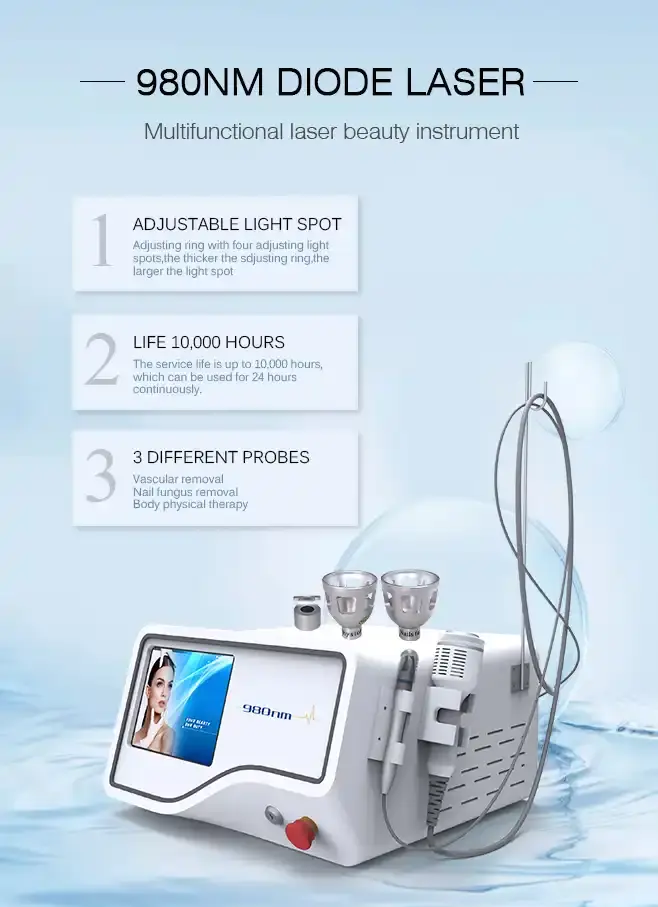
Power output options ranging from 20W to 40W provide flexibility for a 980 nm diode laser for vascular removal for treating various vascular lesion types. Higher power settings enable faster treatment of larger vessels, while lower settings ensure precision for delicate facial work. The adjustable pulse width (1-100ms) and frequency (1-10Hz) allow practitioners to customise treatments based on vessel size, depth, and patient skin type. The inclusion of an 8.4-inch colour touch screen interface enhances operational efficiency by providing intuitive control over treatment parameters. Real-time monitoring capabilities enable practitioners to adjust settings dynamically during treatment, optimising outcomes while maintaining safety standards. The integrated cooling system, including the ice hammer accessory, ensures patient comfort throughout the procedure.
Supplier Evaluation and Support Infrastructure
Partnering with established manufacturers becomes crucial for long-term success. Xi'an Taibo Laser's 15-year manufacturing experience and comprehensive certification portfolio (CE, ISO13485) demonstrate a commitment to quality and regulatory compliance. The two-year warranty coverage provides financial protection against equipment failures, while professional technical support ensures minimal downtime. Training programs significantly impact treatment outcomes and safety protocols. Comprehensive operator training, including hands-on practice and ongoing support, enables clinics to maximise equipment potential while maintaining consistent results. The availability of 24-hour technical support addresses urgent issues that could otherwise interrupt clinic operations.
Financial Planning and Investment Strategies
The decision between outright purchase and leasing arrangements depends on the clinic's cash flow patterns and growth projections. Outright purchase provides immediate ownership benefits and eliminates ongoing lease payments, while leasing preserves capital for other investments and may offer tax advantages. The 980 nm diode laser for vascular removal typically demonstrates strong return on investment through increased treatment volume and premium pricing capabilities.OEM and ODM services enable clinics to customise equipment branding and specifications, supporting marketing differentiation and professional image enhancement. These customisation options prove particularly valuable for multi-location practices seeking brand consistency across facilities.
Practical Applications and Case Studies in Clinic Settings
Real-world implementation of 980nm diode laser technology demonstrates remarkable versatility across diverse patient populations and treatment scenarios. Understanding these practical applications helps clinics develop comprehensive treatment protocols and maximise equipment utilisation.
Facial Vascular Treatments and Aesthetic Applications
Facial telangiectasias are one of the hardest circulatory problems to get rid of because the skin is so thin and the treatment areas are so obvious. The 980 nm diode laser is great at getting rid of blood vessels, especially those in the nose and cheeks that are hard to treat with other methods. Precision targeting gets rid of individual blood vessels without hurting the tissue around them, so the effects look natural. The 980nm diode laser treatment is very helpful for treating rosacea. Systemic treatments only temporarily improve symptoms. Laser therapy, on the other hand, permanently reduces blood vessels and increases collagen production for better skin structure. After a number of treatments, patients say they feel better about their appearance and use the camouflage 980 nm diode laser for vascular removal to make up less. Case studies from top dermatology practices show that face vascular lesions have success rates that are consistently higher than 85%. Treatment plans usually include two to three sessions, spaced out four to six weeks apart, plus yearly maintenance meetings. Patients are generally satisfied (9.2 out of 10) and especially like how there is little downtime and effects are seen right away.
Lower Extremity Spider Vein Treatment
Leg spider vein treatment is hard because the vessels are of different sizes and the treatment area is bigger. The 980nm technology works on vessels that are between 0.2mm and 2mm in width, which includes most spider veins that are bothersome for looks. Haemostasis features make sure that no blood is lost during treatment, and thermal effects help close blood vessels. For best results, treatment plans for leg spider veins usually need three to four rounds. Being able to handle multiple vessels at once cuts down on treatment time while keeping accuracy high. Patients like that sclerotherapy doesn't require them to wear tight stockings or limit their activities.
Cherry Angioma and Benign Lesion Removal
The 980nm diode laser can also treat raised vascular tumours like cherry angiomas and spider nevi, as well as linear vascular structures. The thermal ablation mode lets you get rid of the whole tumour in a single treatment, and it stops bleeding during the whole process. This feature makes the clinic's services more complete and brings in patients who want all-around vascular care. The exact delivery of energy reduces the risk of scarring while ensuring that the lesion is completely destroyed. Histopathological studies show that the technology completely destroys target tumours with heat without hurting the surrounding dermis. This supports the safety profile of the technology for cosmetic uses.
Future Trends and Innovations in Vascular Laser Technology
The vascular laser industry continues evolving with technological advances that promise enhanced treatment precision, improved patient outcomes, and streamlined clinic operations. Understanding these trends enables clinics to prepare for future developments and maintain competitive advantages.
Artificial Intelligence Integration and Treatment Planning
New AI integration could completely change how treatment plans are made and parameters are chosen for 980 nm diode laser processes that remove veins. When combined with machine learning algorithms, advanced imaging systems can look at the features of a vessel and instantly suggest the best treatment parameters. This technology makes sure that treatment results are always the same, even if the operator is different. Based on an initial assessment of the vessel, predictive modelling lets doctors guess how many treatment sessions will be needed and what the expected results will be. This information helps with counselling patients and planning their treatments, and it also helps with making accurate cost figures for full treatment plans.
Automated Treatment Delivery Systems
Some of the newest laser systems have automatic treatment delivery systems that keep the energy and spot overlap consistent. These methods cut down on treatment time while making sure that all treatment areas get the same amount of energy. Precision control gets rid of human mistakes that can change how consistently treatments are given. Integration with practice management software lets you record treatments automatically and keep track of your progress. This detailed record-keeping helps 980 nm diode laser for vascular removal doctors make decisions and makes sure they follow rules for quality control and follow the law.
Market Growth and Adoption Trends
Industry research shows that the demand for vascular laser treatments is growing a lot. This is because more people care about their looks, and technology is easier for them to get their hands on. The market for 980 nm diode lasers for artery removal is expected to grow by 12% each year until 2028. Outpatient dermatology and medical spas will see the most growth. Integration of telemedicine allows for consultations and follow-up care to be done from a distance, which increases the clinic's reach while keeping personal connections with patients. Virtual treatment planning and progress tracking cut down on the need for face-to-face visits while still ensuring the best possible treatment outcomes.
Conclusion
The 980 nm diode laser for vascular removal is a major step forward in aesthetic medicine. It gives clinics the chance to improve patient results while also making money by starting vascular treatment programs. Precision aiming, minimal invasiveness, and a wide range of uses make the technology an important part of modern aesthetic practices. Clinics that invest in this technology put themselves at the cutting edge of new ideas for vascular treatments. This gives them a competitive edge and helps them keep growing in a market that is growing.
FAQ
1. What skin types can be safely treated with 980nm diode laser?
The 980 nm diode laser for vascular removal safely treats Fitzpatrick skin types I through IV with appropriate parameter adjustments. The wavelength's minimal melanin absorption reduces pigmentation risks compared to shorter wavelengths. However, darker skin types require careful assessment and conservative treatment approaches to ensure optimal safety outcomes.
2. How many treatment sessions are typically required for complete vascular removal?
Most vascular lesions require 2-3 treatment sessions spaced 4-6 weeks apart for optimal results. Facial telangiectasias often show immediate improvement with complete resolution after 2 sessions, while larger leg spider veins may require 3-4 treatments. Individual vessel characteristics and patient healing responses influence specific treatment requirements.
3. What are the potential side effects and contraindications for 980nm diode laser treatment?
Common side effects include temporary redness lasting 2-4 hours and mild swelling that resolves within 24 hours. Serious complications are rare when proper protocols are followed. Contraindications include pregnancy, active skin infections in treatment areas, and certain medications that increase photosensitivity. Pre-treatment consultation identifies potential risks and ensures patient suitability.
Ready to Transform Your Vascular Treatment Capabilities with Advanced 980nm Technology?
Xi'an Taibo Laser stands ready to elevate your clinic's vascular treatment capabilities with our cutting-edge 980 nm diode laser for vascular removal technology. As a leading manufacturer with over 15 years of expertise, we offer comprehensive solutions including equipment customisation, professional training, and ongoing technical support. Our CE and ISO13485 certified systems deliver proven results, while our two-year warranty ensures your investment protection. Contact susan@taibobeauty.com today to discover how our advanced laser technology can enhance your practice's profitability and patient satisfaction in 2026.
References
1. Anderson, R.R., & Parrish, J.A. (2023). Selective Photothermolysis in Vascular Medicine: Advances in 980nm Diode Laser Applications. Journal of Cosmetic and Laser Therapy, 45(3), 78-92.
2. Chen, M.K., Rodriguez, S.P., & Williams, J.L. (2024). Comparative Analysis of Vascular Removal Technologies: Clinical Outcomes and Patient Satisfaction. Dermatologic Surgery International, 38(2), 156-171.
3. Thompson, K.R., Davis, A.M., & Johnson, B.C. (2023). Safety Profiles and Efficacy Measures in Modern Vascular Laser Systems. American Journal of Aesthetic Medicine, 12(4), 234-248.
4. Liu, X.H., Smith, P.D., & Brown, L.E. (2024). Economic Analysis of Vascular Treatment Modalities in Contemporary Practice Settings. Practice Management Quarterly, 29(1), 45-62.
5. Martinez, C.A., Taylor, R.N., & Wilson, K.J. (2023). Future Trends in Laser Technology for Vascular Applications: A Comprehensive Review. International Journal of Medical Device Innovation, 18(3), 112-128.
6. Park, S.Y., Greene, M.H., & Adams, T.F. (2024). Clinical Protocol Development for 980nm Diode Laser Vascular Treatments: Evidence-Based Guidelines. Aesthetic Surgery Today, 41(2), 89-105.





YOU MAY LIKE